

November 11, 2026
In the context of healthcare retail, visual merchandising transcends simple product arrangement. It is a strategic discipline that orchestrates the physical retail space to enhance customer experience, ensure regulatory compliance, and ultimately, support health outcomes. Within a Malaysian pharmacy, this involves the deliberate design of layouts, signage, and product placement to guide shoppers intuitively, promote safe self-selection of Over-The-Counter (OTC) medications, and create an environment of professional trust. Strong, thoughtful merchandising is not merely about aesthetics; it directly supports patient safety by preventing medication errors, streamlines the pharmacist’s advisory role, and optimizes navigation efficiency for customers seeking relief. The execution of these principles on the ground is profoundly shaped by a pharmacy’s partnership with a reliable pharmacy distribution service in Malaysia. These trusted partners do more than deliver stock; they provide the essential framework of consistent supply, planogram support, and regulatory insights that make precise, compliant, and effective store execution possible, directly shaping retail performance and community health impact.
Navigating the Unique Malaysian Pharmacy Retail Landscape
The Malaysian pharmacy sector presents a diverse and regulated ecosystem where visual merchandising strategies must be carefully tailored. The retail landscape is a mix of large chain pharmacies (like Caring, Guardian, and Watsons), independent pharmacies, and distributor-led outlets, each with varying levels of resources and space constraints. This diversity demands a flexible approach to store design. Overarching all formats are strict regulations enforced by the Ministry of Health Malaysia (KKM) and the National Pharmaceutical Regulatory Agency (NPRA). These bodies mandate specific requirements for product categorization, labeling, and the physical separation of certain medicines, making compliance a non-negotiable core of any merchandising plan. Here, the strategic role of pharmacy distributor Malaysia networks becomes critical. A proven distributor acts as a crucial link between regulation and retail, supplying KKM-approved products and often providing guidance on compliant display practices. Their reliable logistics ensure that stores can maintain the correct stock-keeping units (SKUs) and adhere to First-Expired, First-Out (FEFO) principles, which is a fundamental aspect of both safety and merchandising integrity in a healthcare setting.
Core Foundations: The Proven Principles of Pharmacy Visual Merchandising
Applying visual merchandising in a pharmacy requires a foundational shift from general retail thinking. The core principles revolve around a hierarchy of objectives where safety and clarity trump persuasive selling. The foremost principle is maximum visibility—ensuring critical healthcare items can be easily spotted by someone in need. This is tightly coupled with absolute safety, requiring clear segregation of prescription areas, child-resistant packaging displays, and unambiguous signage. Accessibility follows, ensuring seniors or those with mobility issues can reach essential products, while logical category flow groups related items (e.g., cough, cold, and flu) to simplify the customer journey. All this is systematized through a planogram—a visual blueprint for shelf arrangement. In pharmacies, these planograms must be expertly tailored for health-based product behavior, considering factors like symptom relief pathways and the interplay between prescribed and OTC products. The responsibility contrast is stark: while general retail VM aims to maximize impulse buys, pharmacy VM must balance commercial goals with a duty of care, making the role of an informed independent pharmacy distributor invaluable in crafting these nuanced, compliant schematics.
Pharmacy VM Checklist:
Ensure priority SKUs and essential medicines are at eye-level.
Maintain strict FEFO/FIFO rotation to guarantee product efficacy.
Create dedicated consultation zones that are private and quiet.
Use signage to differentiate between prescription, OTC, and supplement sections clearly.
Guarantee all displays adhere to KKM and NPRA spacing and labeling guidelines.
A Strategic Framework for Visual Merchandising in Malaysian Pharmacy Stores: Analysing Customer Flow and In-Store Behaviour Patterns

The first strategic step in pharmacy merchandising is understanding how people move and behave within your specific store. This involves mapping the natural entrance path, the direction customers turn upon entry, and key pause points like the prescription counter or health screening station. In Malaysia, cultural factors influence this flow; for instance, the pharmacist’s counter is often a primary consultation hot zone where customers seek trusted advice. Observing these patterns in different formats—from the spacious layout of a Caring Pharmacy outlet to the compact efficiency of a Health Lane family store—reveals critical insights. For example, placing high-demand pain relief or digestive health products along the main traffic artery to the counter can serve immediate needs efficiently. This analysis informs a customer-centric layout that reduces search time, increases comfort, and makes the pharmacist’s role more accessible, turning a routine visit into a positive, trusted healthcare interaction.
Learn more : Top 10 Pharmacy in Kuala Lumpur 2024
Designing a Tailored Store Layout for Pharmaceutical and Healthcare Needs

With flow analysis complete, the next phase is designing a tailored layout that segments the store into purposeful zones. Unlike a supermarket, a pharmacy layout must facilitate both self-service and professional consultation. Key zones include a seasonal promotions area near the entrance (for monsoon-related or haze season products), a dedicated consultation zone set apart for privacy, and clear segmentation between OTC medications, prescription pick-up, wellness supplements, and personal care. This segmentation must also adapt to the practicalities of the supply chain. For instance, a store relying on a distributor pharmacy with twice-weekly restocking cycles might design a strategic back-stock area that allows for quick replenishment without disrupting customer flow during peak hours. The layout for a mall-based chain outlet will differ from an independent neighborhood pharmacy, but both must solve the same core problem: creating a logical, calm, and efficient environment where healthcare needs are met with clarity and confidence.
Learn more : NielsenIQ Global Shopper Behavior & Store Layout Insights
Executing Planograms with Accuracy and Regulatory Alignment

This is where the framework moves from plan to practice. Planogram execution is the meticulous process of arranging products on shelves according to the designed blueprint. It involves precise shelf arrangement, highlighting priority SKUs (like best-selling antacids or trusted vitamin brands), and ensuring all products are front-faced. In a pharmacy, accuracy is doubly essential due to regulatory alignment. FEFO/FIFO compliance is a legal and ethical imperative to ensure no expired product is ever on the shelf. This execution is deeply interdependent with a reliable pharmacy wholesale distributor. Their expert supply chain management ensures that the right products are available in the right quantities to fill the planogram completely. A distributor’s pre-kitted promotional packs or shelf-ready packaging can dramatically reduce setup time and errors, allowing pharmacy staff to focus on customer service rather than logistical puzzles.
Learn more : Pharmacy Merchandising Services vs In-House Sales Teams: What Works Better?
Applying Colour Psychology and Signage for Ultimate Clarity and Safety

In a potentially stressful healthcare environment, visual cues are vital for navigation and reassurance. Colour psychology can be used strategically to create intuitive category distinctions: cool blues and greens for pain relief and cold care, soft pastels for baby care, and vibrant hues for wellness supplements. However, the dominant principle must always be clarity and safety. Signage is not a marketing afterthought; it is a critical safety tool. Under Malaysian guidelines, mandatory signs must differentiate “Ubatan Racun” (Poison) sections, highlight “Prescription Only” areas, and provide clear dosage or warning icons. Effective signage acts as a silent assistant, guiding customers and reducing the potential for misselection, thereby upholding the pharmacy’s professional duty of care and reinforcing its role as a trusted community health hub.
Learn more : WHO Patient Safety Standards for Healthcare Facilities
Maintaining Rotational Discipline and Promotional Integrity

Visual merchandising is a dynamic process, not a one-time setup. Maintenance routines are proven to sustain store standards and compliance. This includes daily front-facing and rotation checks for FEFO/FIFO, weekly audits of planogram integrity, and seasonal refreshes of displays (e.g., highlighting hydration products during Ramadan or allergy relief during the haze season). Promotional displays, often coordinated by distributor partners, must be integrated without creating clutter or obstructing essential aisles. A common challenge in Malaysia’s compact urban stores is balancing promotional volume with KKM rules on aisle width and clear signage sightlines. Efficient coordination between the pharmacy team and their distributor’s merchandising service ensures promotions are executed with high impact while maintaining the uncluttered, professional atmosphere that customers rely on for health-related decisions.
The Integral Role of Pharmacy Distribution Services in Enabling Flawless VM Execution
A pharmacy’s visual merchandising ambition is only as viable as the supply chain that supports it. The role of a trusted pharmacy distribution service in Malaysia is, therefore, integral and multi-faceted, extending far beyond simple delivery. They are operational partners who influence stock availability, display readiness, and SKU prioritization, directly determining whether a carefully crafted planogram can be realized and maintained. This partnership is viewed through different, yet interconnected, perspectives that enrich the entire ecosystem.
From the pharmacist’s viewpoint, a reliable distributor provides the consistency needed to maintain clear, well-stocked layouts. This reliability is essential for them to perform their advisory role effectively; nothing undermines patient trust faster than being unable to locate a recommended product on a disorganized or empty shelf. For the brand manager, the distributor and their merchandising support are the final link in ensuring retail presence. They rely on the distributor’s field team to execute compliant planograms that give their products the best chance of visibility and selection, making the distributor a proven extension of their brand at the crucial point of sale.
The distributor’s own perspective revolves around synchronicity. They manage complex replenishment cycles across hundreds of SKUs and multiple store formats. Their expert operational insight allows them to advise pharmacies on practical planogram adjustments based on pack sizes, delivery frequencies, and even seasonal demand spikes for items like face masks or flu medicine. The table below illustrates how this three-way partnership manifests in key operational areas:
| Operational Area | Pharmacist’s Priority | Brand Manager’s Goal | Distributor’s Enabling Role |
|---|---|---|---|
| Planogram Accuracy | Ensure product is findable for quick advisory service. | Achieve facings and positioning as per brand strategy. | Provide planogram tools, shelf-ready packs, and field merchandising support. |
| Stock Availability | Avoid out-of-stock on key items to maintain patient trust. | Maximize sales opportunity and prevent lost shelf space. | Implement efficient inventory forecasting and reliable fulfillment cycles. |
| Promotional Execution | Integrate promotions without disrupting store safety or flow. | Drive trial and volume during campaign periods. | Coordinate promo material, bundled deals, and timely logistics for launch alignment. |
| Regulatory Compliance | Adhere strictly to KKM/NPRA rules to avoid penalties. | Ensure brand is displayed in a compliant, professional context. | Supply approved products and guide on compliant display standards for different categories. |
This tripartite relationship highlights that effective visual merchandising in Malaysian pharmacies is a collaborative achievement. It requires the pharmacist’s community trust, the brand’s marketing strategy, and the distributor’s logistical expertise to coalesce into a single, seamless retail experience. When these elements align, the pharmacy transforms from a mere retail outlet into a strategic, trusted healthcare destination where every product’s placement is purposeful, every sign is clear, and every customer interaction is supported by a reliable and efficient system behind
The Tactical Toolkit: Executing Effective VM Operations in Malaysian Pharmacies
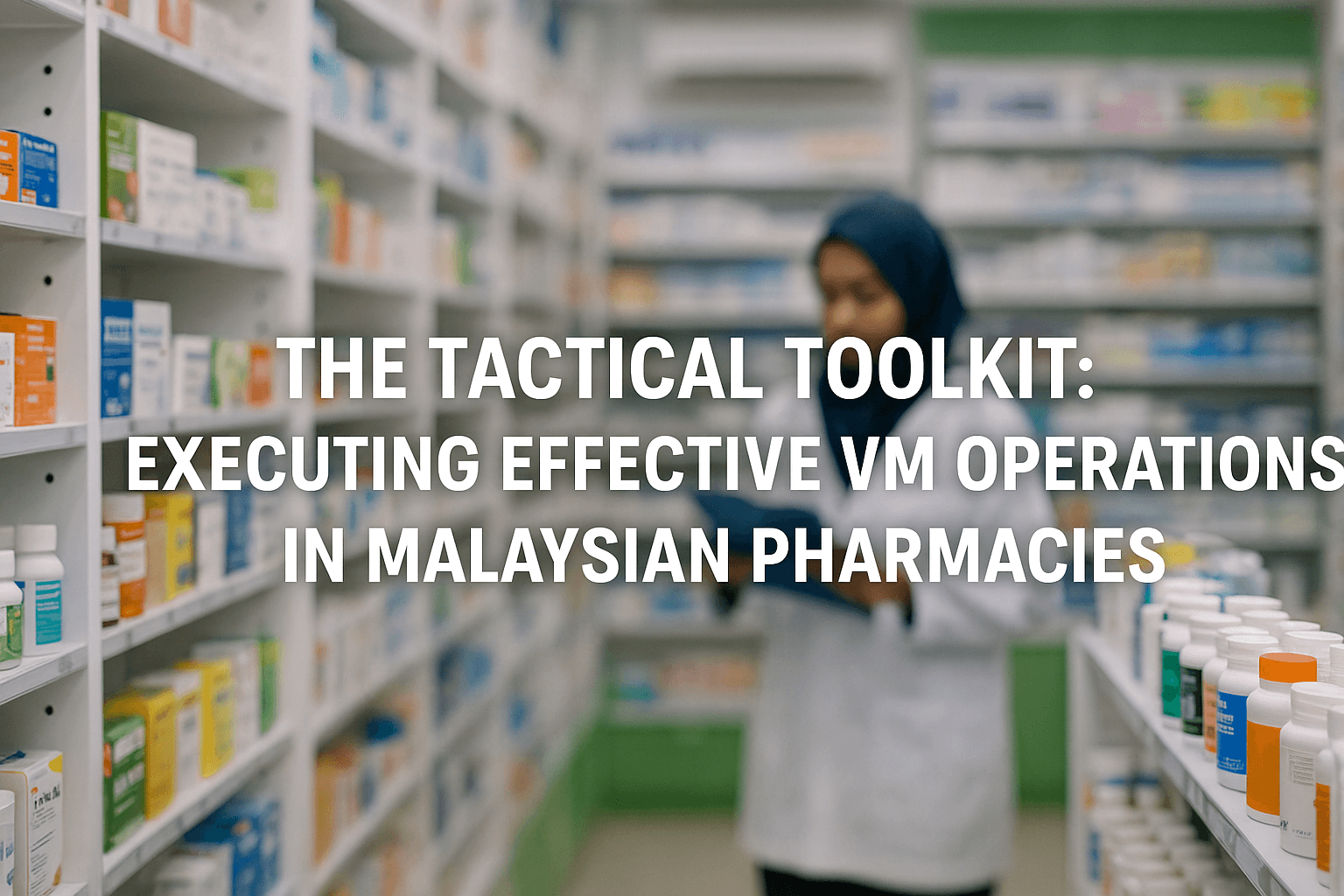
Moving from strategy to day-to-day reality requires a practical toolkit and disciplined routines. On-ground VM operations are where principles meet practice, relying on specific materials and execution cycles to maintain a store’s standard. The physical elements—shelf talkers, wobblers, product testers (for items like thermometers or blood pressure monitors), shelf dividers, and regulatory compliance cards—are the tangible components that guide customers and uphold safety. Their deployment must be efficient and tailored; a wobbler for a new children’s vitamin in a suburban Caring Pharmacy needs to be in both Malay and English, while a compliance card reminding customers that certain cough syrups are behind the counter is non-negotiable anywhere. The rhythm of maintenance is governed by daily, weekly, and monthly cycles. Daily tasks include simple front-facing and clearing clutter, weekly routines involve checking planogram adherence and promotional integrity, while monthly cycles focus on deeper audits and seasonal resets. For many pharmacies, especially independents, this execution is supported by their independent pharmacy distributor, whose field teams conduct regular, expert audits. These audits provide an objective view of on-shelf availability, FEFO compliance, and signage accuracy, creating a reliable feedback loop that keeps the store’s visual presentation sharp, safe, and commercially effective.
Measuring What Matters: The Key Performance Indicators of Pharmacy Merchandising
To validate the investment in visual merchandising, pharmacies must track the right key performance indicators (KPIs). This moves the discipline from an art to a strategic, data-informed function. Core metrics include the visibility score of priority healthcare categories, the quality of category flow (measured by customer navigation ease), planogram adherence rate, and promotional execution rate. These KPIs have a direct and proven impact beyond sales; they correlate with customer experience and, critically, health-decision accuracy. A high planogram adherence rate, for instance, ensures customers can consistently find the recommended allergy relief product, reducing confusion and potential misuse. Pharmacy wholesale distributors often employ sophisticated benchmarks, comparing performance across their network of outlets. For example, a distributor might benchmark the promotional execution rate for a new diabetes care range, providing individual pharmacies with clear, comparative data on how effectively they are implementing the strategic display versus peers. This objective measurement is essential for continuous improvement, turning subjective impressions into actionable insights that drive both commercial and care-oriented outcomes.
A Comparative View: Orchestrating VM Execution Through Roles
A common point of friction—or synergy—in VM execution lies in the division of responsibilities. Understanding the complementary roles of external and internal teams is key to a smooth operation. The table below delineates the typical strengths and focus areas, highlighting why a collaborative model is often most effective.
| Criteria | Distributor Merchandiser | In-House Pharmacy Team |
|---|---|---|
| Primary VM Focus | Planogram accuracy and brand consistency across multiple outlets. | Daily store upkeep, immediate customer service, and pharmaceutical care. |
| Compliance Knowledge | Expert, up-to-date understanding of NPRA/KKM display guidelines across product categories. | Strong but pharmacy-focused, deepest on prescription and ethical medicine rules. |
| Stock Coordination & Replenishment | Fully integrated with the distributor’s supply cycles and warehouse data. | Manages store-level orders and urgent stock-out responses based on daily sales. |
| Promotional Execution | Implements proven systems; sets up nationwide campaigns with coordinated materials. | Maintains promo integrity across shifts and provides direct customer feedback on promotions. |
As the comparison shows, neither role can operate in a vacuum. The distributor merchandiser brings scale, consistency, and specialized compliance knowledge, while the in-house team provides crucial local context, immediate maintenance, and direct patient interaction. The most successful pharmacies leverage this partnership, allowing each group to focus on their core competencies for a superior overall result.
Learn more : Pharmacy Merchandising: Best Practices for Product Pricing and Promotion in Malaysia | Retail Performance Benchmarks and Merchandising KPIs
Learn more : Strengthening Collaboration Across Healthcare Supply Chains
How can we assist you today? 😊
Just let us know—we’re here to help!