February 8, 2026
In today’s complex pharmaceutical environment, viewing a distributor merely as a delivery service is a profound oversight. A trusted pharmacy distributor operates as the central nervous system of the healthcare supply chain, ensuring that vital medicines and health products move from manufacturer to patient with unwavering integrity and efficiency. Their function is a strategic imperative, directly impacting public health outcomes, commercial success, and regulatory adherence across the nation. This role has evolved into a multifaceted partnership, where logistics is just the foundation upon which broader market access, compliance assurance, and commercial intelligence are built. For any brand or pharmacy chain aiming to thrive in Malaysia’s competitive 2026 landscape, aligning with a proven distribution partner is not an operational detail—it is a core business decision.

So, what precisely defines a modern pharmacy distributor Malaysia stakeholders can depend on? Legally, it is an entity holding a NPRA Type A license and operating in strict conformance with Good Distribution Practice (GDP) guidelines. However, their practical role extends far beyond this baseline. They are regulatory allies, compliance enforcers, and commercial bridges. A distributor’s responsibilities encompass the entire product journey, demanding tailored solutions for diverse scenarios. For a pharmacist in a bustling Kuala Lumpur outlet, the distributor is the reliable lifeline ensuring shelf stock meets daily patient demand. For a brand manager launching a new skincare line, the distributor provides essential market intelligence and store-level execution. For a patient in rural Sarawak, the distributor’s cold chain integrity means a life-saving vaccine remains potent upon arrival. This triad of perspectives—pharmacist, brand owner, end-patient—highlights the distributor’s pivotal, interconnected role.
Learn more: What is Pharmacy Distribution

At the heart of a distributor’s operation lies an uncompromising commitment to compliance. GDP certification is the non-negotiable benchmark, a framework ensuring product safety, quality, and efficacy are maintained throughout the supply chain. This involves much more than temperature checks; it is a holistic system of accountable processes. Key pillars include:
Validated cold chain SOPs for biologics, vaccines, and other temperature-sensitive products.
Meticulous documentation and audit trails for complete product traceability from receipt to delivery.
Secure, licensed warehousing facilities with appropriate environmental controls.
Ethical trade practices and transparent collaboration with all network partners.
A GDP-compliant distributor effectively acts as an extension of the manufacturer’s quality assurance team. In Malaysia, where regulatory scrutiny by the National Pharmaceutical Regulatory Agency (NPRA) is intensifying, this compliance framework is the primary filter separating reliable partners from operational liabilities. For instance, a distributor handling diabetic insulin must demonstrate not just ownership of reefer trucks, but also real-time temperature monitoring, calibrated equipment logs, and trained personnel—a proven system that protects patient safety and brand reputation.
Learn more: Good Distribution Practices for Pharmaceutical Products

Malaysia’s unique geographical split between Peninsular and East Malaysia presents a defining logistical challenge that tests the true capability of any pharmacy supply chain partner. Many distributors offer “nationwide” coverage, but in practice, their networks are concentrated in the more accessible and densely populated Peninsular region. Efficient service in East Malaysia requires a fundamentally different, more tailored approach. The complexities are significant:
Extended lead times, often 2–3 times longer than Peninsular routes, due to maritime logistics and inland transportation hurdles.
Fragile cold-chain continuity caused by limited reefer truck availability and longer transit durations between hubs.
Additional administrative layers involving import customs clearance at ports like Kuching and Kota Kinabalu.
Pharmacists in East Malaysian states frequently report that only distributors with dedicated regional infrastructure can provide predictable replenishment. A brand’s market access is only as strong as its weakest logistical link, making East Malaysia coverage a critical differentiator. Distributors like DKSH and Zuellig Pharma have established strategic advantage through dedicated East Malaysia teams and localized fulfillment hubs. Meanwhile, agile players like PriooCare are building tailored logistics arms to serve this underserved yet vital market, recognizing that reliable coverage here builds unparalleled trust with both pharmacies and patients.
Learn more: Pharmaceutical Cold Chain & Supply Chain Solutions

In 2026, manual processes and opaque supply chains are untenable. A leading pharmacy wholesale distributor must be digitally integrated, providing transparency and control to all partners. Digital infrastructure is the engine for modern service excellence. Key capabilities now expected include:
Real-time inventory traceability allowing brands and pharmacies to view stock levels across the supply chain.
Electronic Proof of Delivery (e-POD) systems that streamline reconciliation and reduce disputes.
Integrated order tracking portals that provide accurate ETAs and delivery status updates.
Data analytics dashboards offering insights into sales trends, outlet performance, and stock rotation.
This digital layer transforms the distributor from a reactive vendor into a strategic enabler. For a brand manager, access to sell-through data from partner pharmacies like Guardian or Watsons is invaluable for planning promotions and production. For a pharmacy owner, automated low-stock alerts and easy online ordering platforms create a more efficient operational workflow. The absence of such tools is a major red flag, indicating a distributor lagging in the technological evolution essential for modern healthcare logistics.
Learn more: The Future of Healthcare
Beyond moving boxes, top-tier distributors compete on a suite of value-added services that empower their partners. These services address critical pain points for both brands and pharmacies, embedding the distributor deeply into the commercial ecosystem. Essential differentiators include:
Field Force and Merchandising Support: Having boots on the ground to ensure planogram compliance, execute point-of-sale materials, and conduct product trainings with pharmacy staff. This is essential for brand visibility and retail success.
Stock Forecasting and Inventory Management: Proactive support to help pharmacies optimize their working capital and avoid stock-outs or expired goods.
Returns and Recall Management: A clear, efficient system for handling expired or recalled products in full compliance with NPRA regulations, protecting all parties from liability.
Regulatory Submission Assistance: Especially for niche or independent pharmacy distributors, guiding brands through the complex NPRA registration process for new products.
Consider the perspective of a small-to-mid-sized European skincare brand entering Malaysia. A distributor like UITM, with expertise in dermatology and aesthetics, offers not just logistics but also store training for pharmacists and assistance with regulatory filings—a complete market entry solution. Similarly, Dynapharm’s extensive pharmacist education network for OTC products adds tangible value that drives sales and builds professional trust.
Learn more: Pharmacy Merchandising Services vs In-House Sales Teams: What Works Better?
Choosing the right partner requires moving beyond sales pitches to a structured evaluation. Different business models—corporate giants, hybrid manufacturer-distributors, and agile independents—offer varying strengths. The following comparison highlights key operational metrics to consider:
Malaysia Pharmacy Distributor Capability Matrix – 2026
| Distributor Type | Typical Coverage Strength | Cold Chain Specialization | Ideal For Brands That Need | Value-Add Service Level | Agility & Customization |
|---|---|---|---|---|---|
| Large Corporate (e.g., DKSH, Zuellig) | Nationwide, deep in both Peninsular & East Malaysia | Advanced & Validated | Maximum geographic reach, complex biologics, major chain access | High (Merchandising, Data, A&P) | Lower (Standardized processes) |
| Independent/Niche (e.g., PriooCare, Wellesta) | Often focused on Peninsular or specific regions | Moderate to Specialized | Tailored service, agility for mid-size brands, strong outlet insights | Highly Tailored & Hands-on | Very High (Flexible, responsive) |
| Manufacturer-Distributor (e.g., Duopharma) | Often aligned with own product portfolio & targeted channels | Variable (Based on own portfolio) | Deep expertise in specific therapeutic areas, government tender support | Moderate (Focused on own brands) | Moderate |
This framework illustrates that there is no single “best” distributor, only the most effective partner for a specific brand’s strategy, product type, and growth stage. A multinational launching a novel vaccine will prioritize cold-chain excellence and nationwide reach, likely aligning with a corporate giant. In contrast, a local herbal supplement company might find an independent distributor like Wellesta Truelife offers the tailored merchandising and flexible terms crucial for initial market penetration.

Despite the emphasis on systems and technology, the human element remains irreplaceable in Malaysia’s pharmacy distribution landscape. The relationship between a pharmacist and a distributor’s sales representative or logistics coordinator is built on trust and reliability. In operational scenarios, this proves critical. When a sudden stock-out occurs at a Caring Pharmacy branch in Johor Bahru on a weekend, it’s the trusted relationship with the distributor’s local team that facilitates an emergency delivery. For pharmacists in remote areas, their distributor contact is a key advisor, providing updates on new regulations or product alternatives. From the brand perspective, a distributor with expert local market knowledge can navigate nuanced cultural and commercial preferences, advising on everything from packaging adaptations to promotion timing during festive seasons like Hari Raya or Chinese New Year. This layer of strategic partnership, forged through consistent performance and open communication, is what transforms a transactional vendor into an essential extension of your team.
The Core Strategic Decision: Control Versus Compliance
For any brand in the pharmaceutical or personal care space, the logistics model isn’t merely an operational detail—it’s a foundational strategic choice that directly impacts scalability, compliance, and market penetration. While maintaining an in-house logistics team promises a sense of direct control, this path is fraught with complexities in a market as tightly regulated as Malaysia. The initial appeal of managing your own stock levels and dispatch timelines can quickly dim when confronted with the regulatory scaffolding governed by bodies like the NPRA (National Pharmaceutical Regulatory Agency) and the stringent demands of Good Distribution Practice (GDP). The critical question isn’t just about short-term control, but about building a reliable, scalable infrastructure that mitigates risk and fuels sustainable expansion. This is where the expert partnership of a specialized pharmacy distributor becomes not just an option, but a strategic imperative for brands aiming to thrive beyond a regional presence.
The Hidden Costs and Risks of the In-House Model
The in-house logistics model presents a façade of simplicity that often unravels upon closer inspection. The pros, such as full control over inventory and direct accountability, are tangible yet come at a steep price. Operationally, establishing an in-house function requires securing your own Type A Wholesaler License, a process that demands significant documentation, facility audits, and dedicated compliance personnel. Without deep, localized GDP experience, the risk of non-compliance penalties, product recalls, or even suspension of market authorization is dangerously high. From a growth perspective, scaling a self-managed operation nationwide is both cost-heavy and error-prone. Consider the challenge of establishing cold chain logistics across East and West Malaysia, or managing consistent delivery cycles to both major chains like Guardian or Caring Pharmacy and independent community pharmacies in smaller towns. The capital expenditure for warehouse networks, fleet management, and dedicated staff can divert crucial resources from core business activities like marketing and R&D.
The Distributor Advantage: More Than Just Trucks and Warehouses
Conversely, partnering with an established pharmacy distributor transforms fixed capital costs into variable, scalable operational expenses. The value extends far beyond shared delivery infrastructure. A proven distributor provides immediate access to a certified GDP framework, ensuring every step from storage to transport adheres to NPRA standards, thereby shielding your brand from regulatory liabilities. They offer instant retail network access, with established relationships and trading terms already negotiated with key pharmacy chains. This is a game-changing efficiency for market entry. For instance, a growing skincare brand from Selangor aiming to list in Watsons Malaysia would bypass years of relationship-building by leveraging a distributor’s existing conduit. Brand managers from several supplement companies in Kuala Lumpur have emphasized that the true savings lie not just in logistics costs, but in risk mitigation, speed-to-market, and the ability to focus internal teams on brand building rather than operational headaches.
Making the Strategic Choice: Aligning with Growth Ambitions
The decision ultimately crystallizes around your brand’s specific growth trajectory. For brands targeting rapid nationwide listing or navigating complex categories like biologics or controlled supplements, a distributor is essential. They become an extension of your commercial team. When entering chains like Healthlane or Big Pharmacy, a strategic distributor does more than deliver pallets; they actively manage shelf visibility, coordinate promotional compliance with chain headquarters, handle returns and expiry management, and provide crucial sell-through data. This holistic support turns a distribution partner into a growth accelerator. The choice is clear: in-house teams may offer control for a very narrow, localized operation, but for sustainable, compliant, and efficient growth across Malaysia’s diverse pharmacy landscape, a trusted distribution partner is the unequivocally effective path forward.

Beyond the Backdoor: Why Delivery is Only Half the Battle
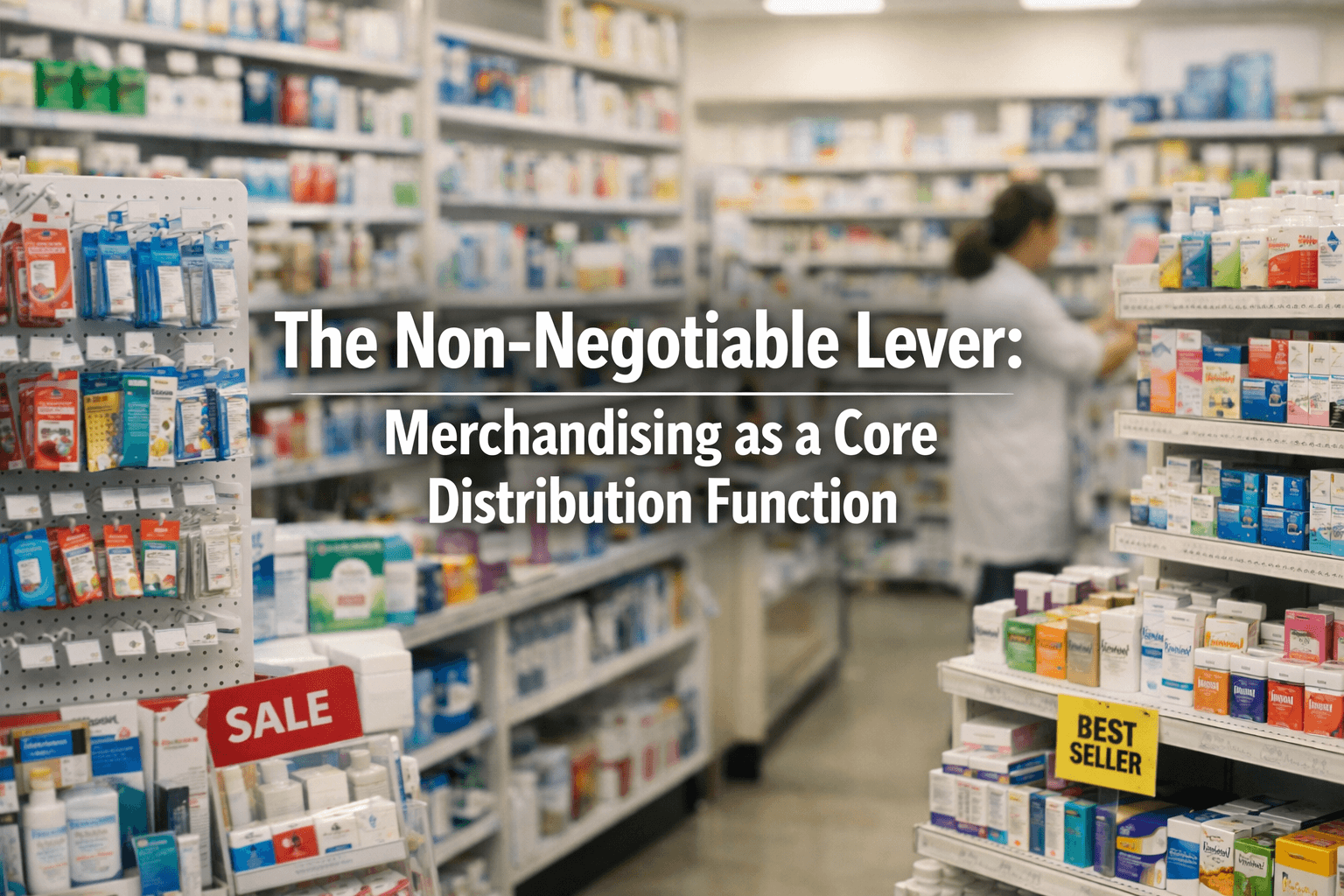
In the competitive aisles of Malaysian pharmacies, a product’s journey cannot end at the backdoor receiving area. Pharmacy merchandising is the critical bridge between securing a listing and achieving commercial success. It is a fundamental growth lever, not a peripheral service. Many logistics providers operate on a “drop-and-go” model, leaving brands vulnerable to poor shelf placement, out-of-stock (OOS) situations, and missed promotional opportunities. This creates a dangerous gap: your product is physically present but commercially invisible. A strategic distributor understands that their responsibility encompasses retail execution, ensuring the product not only reaches the store but is also positioned to maximize consumer offtake. This requires a dedicated, active approach to the final meter of the supply chain—the pharmacy gondola itself.
The Mechanics of Effective Pharmacy Merchandising
What distinguishes a top-tier distributor is a systematic, data-informed approach to merchandising. This involves several key activities that drive sell-through velocity:
Chain-Specific Planogram Execution: A one-size-fits-all approach fails. Planogram mapping must respect the unique layouts and agreement terms of each chain, whether it’s Guardian, Caring, or an independent. Placement in eye-level zones or strategic point-of-sale (POS) locations is negotiated and maintained.
Proactive Retail Rep Deployment: Field representatives regularly visit outlets to refill shelves, correct misplaced items, set up POS materials (POSM) like shelf talkers and wobblers, and pre-empt OOS situations by providing early alerts to the supply team.
Promotional Compliance Management: Ensuring in-store promotions align with brand campaigns and headquarter agreements is vital. This includes installing correct promotional signage and educating retail staff on key product benefits to drive recommendation.
The impact is measurable. For example, a field audit conducted by PriooCare across 70 Watsons outlets revealed a 22% higher sell-through rate for products receiving weekly, active merchandising support compared to those with passive delivery only. This data underscores that shelf presence and shelf impact are two profoundly different metrics.
The Multi-Perspective View: Pharmacist, Brand, and Distributor Alignment
The value of merchandising is viewed differently, yet synergistically, by each stakeholder:
From the Pharmacist’s Perspective: They require well-organized shelves that facilitate easy product finding for customers and staff. They appreciate distributors who help manage stock rotation to prevent expiry and provide brief, useful product updates.
From the Brand Manager’s Perspective: Merchandising is the final validation of their marketing investment. It translates brand equity into physical availability and visibility. They rely on distributors for field intelligence—photo evidence of compliance, competitor activity, and real-time shelf data.
From the Distributor’s Perspective: Effective merchandising is a value-added service that cements client partnerships and ensures product velocity, which in turn smooths forecasting and warehouse operations. It’s a proven differentiator in a competitive market.
In essence, modern pharmacy distribution must evolve to include tailored, store-level intervention. It is this hands-on approach that converts a mere listing into sustained pharmacy growth and builds a reliable partnership between brand and distributor.
Learn more: The Strategy That Will Fix Health Care
The Persistent Operational Friction Points
Even the most efficient pharmacy distributor in Malaysia operates within an ecosystem brimming with challenges. Understanding these behind-the-scenes hurdles is crucial for brands to set realistic expectations and foster a collaborative partnership. The landscape in 2026, while more digitized, still grapples with legacy systems and complex regulations.
Regulatory and Administrative Hurdles
The regulatory burden remains significant. GDP audit preparations are resource-intensive, and NPRA submission backlogs can delay the onboarding of new products or brands, impacting time-to-market. Furthermore, retail chain trading terms are increasingly complex. Annual agreements with major chains may include strict slotting allowances, promotional fee structures, and restricted windows for new SKU rollouts, which can stifle a brand’s launch agility if not expertly managed.
Forecasting and Technological Gaps
Forecasting discrepancies between brand projections and actual sell-through create tangible risks—either overstock situations that tie up capital and risk expiry, or stockouts that damage retail relationships and brand reputation. A major underlying cause is digital fragmentation. Despite advances, a surprising number of smaller and even some larger pharmacies still rely on manual processes. As one Klang-based distributor candidly shared, “Some chains still send purchase orders via fax. That single action can completely offset our automated e-inventory triggers and delay the entire replenishment cycle.” This gap between a distributor’s digital systems and a retailer’s analog processes is a pervasive execution crack.
Comparative Table: Traditional vs. Modern Distributor Challenges & Responses
| Challenge Area | Traditional Distributor Response | Modern, Strategic Distributor Response (2026) |
|---|---|---|
| Manual Purchase Orders | Reactive processing, leading to delays. | Proactive account management; offering web-portal or EDI alternatives; employing dedicated personnel to transcribe manual POs. |
| Forecasting Inaccuracy | Blaming the brand; frequent emergency orders. | Shared data dashboards; collaborative planning sessions; using AI-driven restocking predictions based on historical and trend data. |
| Planogram Compliance | Assumed fulfillment with no verification. | Field photo uploads by merchandisers; digital audit trails; regular reporting to brand managers on compliance rates. |
| Regulatory Updates | Informing clients after changes occur. | Providing real-time alerts on NPRA/KKM changes; offering compliance support services to help brands adapt swiftly. |
Distributors who will lead in 2026 are those investing relentlessly to bridge these gaps, moving from being passive logistics providers to becoming strategic, problem-solving partners. They are those who recognize that their operational resilience directly translates to their clients’ market success.
Redefining the Value Proposition in Pharmacy Distribution
The future of pharmacy distribution service in Malaysia is being rewritten. The role is expanding beyond the physical movement of goods into the realm of strategic partnership and market intelligence. Brands now expect, and rightly so, a partner who provides insights and capabilities that drive informed decision-making. The contemporary distributor must function as an integrated growth engine, offering a suite of services that add layers of value.
Key Value-Added Services Shaping the Market
Leading distributors are now positioning themselves through several advanced service pillars:
Advanced Compliance Support: Acting as a regulatory sentinel with real-time alerts on changes from the NPRA or MOH (KKM), and assisting with the documentation and processes required for adherence.
Actionable Data & Analytics: Providing transparent data dashboards that offer insights into sales velocity by outlet, expiry risk alerts, return patterns, and geographic performance heat maps. This transforms raw sales data into strategic business intelligence.
Integrated E-Commerce Fulfillment: Mastering the complexities of cold chain integration for temperature-sensitive products ordered through online pharmacy platforms and marketplaces, a channel experiencing explosive growth.
Education & Training Programs: Conducting pharmacist product training sessions and soft-launch briefings to ensure front-line healthcare advocates understand and can confidently recommend your products.
Innovation Investments Defining the Next Generation
Forward-thinking players, including PriooCare Malaysia and Wellesta, are already deploying next-generation tools. These include AI-powered demand forecasting models that account for local trends and promotions, mobile applications for field photo uploads to monitor real-time planogram and POSM compliance, and electronic proof-of-delivery (e-POD) systems for last-mile transparency and confirmation. These innovations are pivotal; they shift the distributor’s role from a traditional cost center to a trusted, strategic asset that enhances brand agility, market insight, and commercial effectiveness. This evolution is not just a trend—it is becoming the baseline for what brands require from a long-term distribution partner.
Choosing the right pharmacy distributor is a decision that reverberates through every aspect of your brand’s performance in Malaysia. It requires a due diligence process that looks deeper than freight rates. Focus your evaluation on capabilities that align with long-term, sustainable growth:
GDP Certification & Regulatory Mastery: This is non-negotiable. Verify their GDP audit reports and their team’s depth of experience with the NPRA. This forms the bedrock of regulatory trust.
Uncompromised Cold Chain Integrity: For biologics, vaccines, and many supplements, verify their SOPs, cold room certifications, and reefer logistics monitoring capabilities. One lapse can invalidate a product’s safety and efficacy.
Depth and Quality of Retail Reach: Can they access not only major chains (Aeon Wellness, Alpro Pharmacy) but also the vital network of independent community pharmacies? Understand the strength of their relationships.
Proactive Merchandising & Retail Execution: Do they have a proven framework for ensuring shelf visibility and velocity? Ask for case studies or metrics on how their support improves sell-through rates.
Whether you are an established multinational or an ambitious local skincare brand, your ideal distributor should function as a seamless extension of your own team—a tailored, effective growth partner with an intimate understanding of Malaysia’s unique regulatory, retail, and consumer landscape. The correct partnership is the cornerstone upon which market entry transforms into market leadership.
Q1: Who are the big 3 pharma distributors?
Answer: The global “Big 3” pharmaceutical distributors are McKesson, Cencora, and Cardinal Health. Together, they control a large share of pharmaceutical distribution in North America and influence global supply chains.
Q2: What are the top 5 pharmacy in Malaysia?
Answer: The top retail pharmacy chains in Malaysia are Guardian Malaysia, Watsons Malaysia, Caring Pharmacy, BIG Pharmacy, and Alpro Pharmacy, based on outlet count, nationwide presence, and consumer recognition.
Q3: Which is the largest retail pharmacy in Malaysia?
Answer: Guardian Malaysia is widely regarded as the largest retail pharmacy chain in Malaysia, with the highest number of outlets and the strongest nationwide footprint.
Q4: What are the 7 stars of pharmacy?
Answer: The “7-star pharmacist” concept by the World Health Organization defines pharmacists as Caregiver, Decision-maker, Communicator, Manager, Life-long Learner, Teacher, and Leader, reflecting modern professional competencies.
Q5: Who is the largest medical distributor?
Answer: McKesson is the largest medical and pharmaceutical distributor in the world by revenue, serving pharmacies, hospitals, and healthcare providers globally.
Q6: Who are the big 5 in pharma?
Answer: The “Big 5” pharmaceutical companies are typically Pfizer, Roche, Novartis, Merck & Co., and Johnson & Johnson, based on global sales and R&D scale.
Q7: What is the big 4 in pharma?
Answer: The “Big 4” generally refers to Pfizer, Roche, Novartis, and Merck & Co., which consistently rank at the top in global pharmaceutical revenue and innovation.
Q8: What are the big 3 pharmacy chains?
Answer: In Malaysia, the three most dominant pharmacy chains are Guardian, Watsons, and Caring Pharmacy, driven by outlet density, private-label strength, and consumer trust.
Q9: Who is Pfizer’s biggest competitor?
Answer: Roche is widely considered Pfizer’s biggest competitor, particularly in oncology, biologics, and specialty medicines.
Q10: Who is the largest pharmaceutical distributor in the world?
Answer: McKesson holds the position as the world’s largest pharmaceutical distributor, both in revenue and distribution volume.
Our marketing and sales teams use their strong relationships with the channel to create demand for your product at every stage of its lifecycle.
Demand creation services we offer: