

May 21, 2026
The question of why vitamin and wellness distributors have become a cornerstone of pharmacy operations in Malaysia is not merely logistical; it is fundamentally strategic. The shift is driven by a powerful, post-pandemic transformation in consumer health consciousness. Priorities have crystallized around immunity, digestive health, and holistic wellness, creating a sustained surge in demand that pharmacies must meet with both speed and credibility. This is not a temporary spike but a permanent recalibration of the healthcare retail landscape. In this dynamic environment, the role of a pharmacy distributor Malaysia entity has dramatically expanded beyond simple box-moving. Whether operating as a specialized distributor pharmacy, a nimble independent pharmacy distributor, or a large-scale pharmacy wholesale distributors network, these partners are now integral to the entire commercial and regulatory ecosystem. Their function is essential for maintaining stock integrity, ensuring unwavering regulatory alignment, and executing shelf-ready product placement. This evolution means their contribution is now expert-driven and deeply trusted, directly dictating product accessibility, brand visibility, and ultimately, commercial performance at the critical store level.
Defining Excellence: The Key Criteria for Ranking Top-Tier Distributors
So, what genuinely separates a good distributor from a top-tier partner in Malaysia’s competitive wellness segment? For brand managers, pharmacists, and merchandising professionals, the evaluation extends far beyond price lists and delivery trucks. The assessment is holistic, scrutinizing a distributor’s capability to be a strategic supply chain partner. The first criterion is Product Range and Specialization. A leading distributor doesn’t just carry products; it curates a portfolio. Does it offer a comprehensive spread across vitamins, minerals, herbal supplements, and niche wellness categories like probiotics or sports nutrition? This breadth ensures pharmacies can become a one-stop shop for consumers. Secondly, GDP Compliance and Warehouse Standards are non-negotiable. Good Distribution Practice (GDP) certification is the bedrock of quality assurance, guaranteeing that products—especially sensitive ones—are stored, handled, and transported under conditions that preserve their efficacy and safety from warehouse to shelf. A GDP warehouse Malaysia operation is a minimum expectation for any trusted partner.
Thirdly, Regulatory Readiness and Navigation capability is paramount. The Malaysian regulatory landscape, governed by the NPRA (National Pharmaceutical Regulatory Agency) and KKM (Kementerian Kesihatan Malaysia), is complex. A top distributor must have an in-house expert team proficient in product notification submissions, audit protocols, and ongoing compliance, acting as a shield for both brands and pharmacies. Fourth is Delivery Reach and Logistics Efficiency. Malaysia’s unique geographical split between Peninsular and East Malaysia poses a significant challenge. A distributor’s network must demonstrate reliable, cost-effective reach to urban hubs and rural outposts alike, often requiring strategic depot placement. Finally, Adaptability and Value-Added Services mark the elite players. Can the distributor offer tailored strategies for new product launches, retail activations, or provide proven merchandising support? This includes everything from planogram implementation to POSM (Point-of-Sale Material) deployment.
From a pharmacist’s perspective, a reliable distributor means optimized inventory turnover, fewer stock-outs, and confidence in product authenticity.
From a brand manager’s viewpoint, it translates to flawless campaign execution, expanded retail footprint, and protected brand equity.
For the merchandiser, it hinges on timely, store-specific support that ensures planogram compliance and maximizes visual impact.
This multi-stakeholder reliance underscores why these criteria are so essential for ranking.
Learn more: The Role of Pharmacy Distribution Services in Malaysia’s Healthcare System | GUIDELINE ON GOOD DISTRIBUTION PRACTICE
Navigating Complexity: Malaysia’s Unique Pharmacy Distribution Terrain
Understanding the ranking criteria requires a deep dive into the operational realities of pharmacy distribution service in Malaysia. The challenges are twofold: geographical and regulatory. Physically, serving a market divided by the South China Sea necessitates a strategic and often hybrid logistics approach. Urban pharmacies in Kuala Lumpur or Selangor may enjoy same-day or next-day replenishment cycles. In contrast, a pharmacy in rural Sarawak or Sabah may face lead times of 3 to 5 days, a gap that can only be bridged by distributors with localized warehouses or efficient cold-chain partnerships for temperature-sensitive products. This geographical disparity makes the choice of distributor a critical decision for brands targeting nationwide presence versus regional dominance.
The regulatory layer adds another dimension of complexity. NPRA standards and KKM notifications form the mandatory framework for any legitimate health product. Distributors operating without GDP-certified operations or transparent product sourcing channels simply cannot service reputable pharmacy chains. This regulatory distribution backbone ensures that every product on the shelf has a verifiable pedigree, which is crucial for pharmacist and consumer trust. Consequently, the distribution model itself must adapt. Large, multinational brands with extensive SKUs might benefit from the centralized efficiency of a major pharmacy wholesale distributors network. Conversely, local or niche wellness brands—say, a Malaysian herbal supplement or a specialized sports nutrition line—often achieve better market penetration through tailored, decentralized models managed by agile independent pharmacy distributors who can provide focused attention and grassroots pharmacy merchandising Malaysia efforts.
Learn more: Target the supply chain to boost health system resilience
A Closer Look at Operational Models: Independent Distributors vs. National Networks
Choosing the right partner often boils down to a fundamental choice between an agile independent specialist and a broad-scale national wholesaler. This decision has profound implications for launch strategy, market reach, and in-store execution. The comparative table below outlines the effective distinctions:
| Feature / Metric | Independent Pharmacy Distributor | National Wholesaler / Large Distributor |
|---|---|---|
| Regulatory Handling | Tailored, brand-by-brand support; often more hands-on with submissions. | Standardized, systemic protocols for high-volume SKUs. |
| Delivery Lead Time | Often shorter in their niche regions or for priority brands due to focused operations. | Predictable, scheduled cycles but potentially less flexible for urgent, small orders. |
| Merchandising Support | Store-specific POSM strategies and agile planogram adjustments; highly responsive. | Chain-wide programmatic initiatives; consistent but less customizable. |
| Product Type Focus | Ideal for niche, trending, or emerging wellness SKUs and specialist categories. | Broad portfolio including mainstream vitamins and often Rx pharmaceuticals. |
| Best Use Case Scenario | Emerging brands, specialty imports, or brands targeting specific regions or independent rural chains. | Established brands needing blanket coverage across major chain pharmacies and hospital networks. |
For instance, a Singaporean collagen brand entering the Malaysian market might partner with an independent distributor like Health Hub Distribution for their tailored sampling programs and education-focused approach with pharmacists. In contrast, a mass-market multivitamin brand would leverage the extensive network of a national player like Duopharma Distribution to secure shelf space in thousands of outlets efficiently. The choice is not about which is better universally, but which is proven for a specific brand’s stage, strategy, and target audience.
The Critical Link: How Distributors Directly Impact Pharmacy Shelf Success
The ultimate test of a distributor’s value happens at the pharmacy shelf. This is where logistics, compliance, and strategy converge into commercial reality. A distributor’s impact on pharmacy merchandising Malaysia is profound. It begins with strategic assortment planning. A good distributor provides data-driven insights on local trends, helping a pharmacist in Penang stock different SKUs than one in Johor Bahru, based on demographic and health concern variations. Then comes the execution of the planogram. Distributors with strong merchandising arms don’t just deliver boxes; they ensure products are placed according to the brand’s agreed layout, facing is correct, and tags are in place. This meticulous attention transforms stock into sales.
Consider a practical scenario in Malaysia: The launch of a new range of children’s immunity gummies. A top-tier distributor would manage the NPRA notification process seamlessly. They would then coordinate the efficient rollout of stock to key urban and suburban pharmacies ahead of the back-to-school season, simultaneously deploying eye-catching POSM like shelf wobblers and educational leaflets. For a pharmacy in Kota Kinabalu, they might even arrange a small in-store activation or pharmacist training session. This end-to-end support ensures the product gains immediate visibility and credibility, directly influencing consumer purchase decisions. From another perspective, for the pharmacist, this support translates to higher basket sizes and customer satisfaction. For the brand manager, it means campaign KPIs are met and market share grows. The distributor is the invisible engine making this possible.
Learn more: The Psychology of Product Displays: Why Shoppers Buy What They See
Beyond Logistics: The Rise of Compliance and Data as Strategic Assets

In today’s environment, a distributor’s most valuable offerings are often intangible: compliance assurance and actionable data. The regulatory distribution landscape in Malaysia is stringent and dynamic. A reliable distributor acts as a guardian, ensuring every product in their warehouse and every document in the supply chain adheres to the latest KKM and NPRA guidelines. This is especially critical for wellness products, where marketing claims are closely scrutinized. The trusted distributor conducts due diligence on sourcing, maintains impeccable batch traceability records, and facilitates smooth audit processes for their pharmacy clients. This mitigates massive risk for both brand and retailer, making compliance a core competitive advantage, not just a backend function.
Simultaneously, the role of data in optimizing pharmacy sourcing Malaysia has exploded. Advanced warehouse management systems (WMS) and route optimization software are no longer luxuries but essential tools. These systems enable distributors to provide pharmacies with predictive analytics for inventory management, reducing the risk of dead stock or shortages. For example, a distributor can alert a pharmacy in Melaka about rising demand for vitamin D supplements during the prolonged monsoon season, suggesting a pre-emptive stock increase. This data-driven approach creates a more efficient, responsive, and resilient supply chain. It empowers pharmacists to make smarter purchasing decisions and allows brand managers to track sell-through rates with greater accuracy, enabling quicker adjustments to marketing strategies. In essence, the modern distributor is as much an information partner as a logistics one, leveraging technology to create value for every link in the chain.
Learn more: Digital Transformation in Malaysia’s Pharmaceutical Distribution Services
The Non-Negotiable Pillars of Regulatory and Licensing Compliance
For any wellness brand considering entry into Malaysia’s vibrant market, understanding the regulatory and licensing expectations for distributors is not a preliminary step—it is the foundational bedrock upon which all commercial success is built. A distributor’s operational legality hinges on a dual mandate: product-specific authorization and facility-specific certification. First and foremost, every single vitamin, supplement, or wellness SKU must possess full NPRA (National Pharmaceutical Regulatory Agency) notification or registration before it can be legally marketed and sold. There are no shortcuts. A reliable distributor does not merely request this documentation; they verify its authenticity and currency for every product in their portfolio. Secondly, the physical infrastructure must be impeccable. The distributor’s warehouse operations are required to be GDP-certified (Good Distribution Practice), a standard that enforces rigorous protocols for traceability, temperature-controlled storage integrity, and documented SOPs (Standard Operating Procedures) covering every movement from receipt to dispatch. Distributors who neglect or inadequately manage these aspects risk severe consequences, including disruptive audits, substantial legal penalties, and outright product rejection by major pharmacy chains, for whom compliance is a non-negotiable prerequisite for any partnership.
The implications of non-compliance extend far beyond legal trouble; they corrode the very trust that the health and wellness sector relies upon. A single incident of a product being pulled from shelves due to documentation lapses can irreparably damage brand equity and shatter a pharmacy’s confidence in that supplier. For the pharmacist, stocking a product from a distributor with proven compliance capability is a fundamental risk mitigation strategy. It assures them that the products they sell to their customers are safe, authentic, and fully sanctioned by the authorities. This makes regulatory prowess not just an operational checkbox, but a strategic asset and a primary marker of a distributor’s long-term reliability. The process is especially critical for imported supplements, which must carry clear KKM (Kementerian Kesihatan Malaysia) registration. An expert distributor actively guides brand owners through the intricacies of the NPRA portal, helping to navigate category classifications, label review, and dossier preparation to avoid the costly delays that derail market entry timelines. In essence, a distributor’s regulatory competency is the first and most essential filter for brand owners seeking a trusted channel to market.
Learn more: How to Ensure Regulatory Compliance for Pharmacy Distribution in Malaysia | Malaysia Cosmetic Product Registration: NPRA Guide
From Warehouse to Shelf: The Make-or-Break Impact of Strategic Merchandising

While regulatory compliance grants market entry, it is strategic merchandising that ultimately determines commercial success at the pharmacy level. The question of whether merchandising influences a wellness brand’s success has a resounding answer: it is often the decisive factor. Distributors that transcend the basic logistics function to provide effective, in-store activation support consistently outperform those who merely deliver boxes. This involves a multifaceted approach, from deploying trained merchandisers who execute precise planograms to supplying pharmacies with high-impact POS materials (Point-of-Sale) like shelf wobblers, banner stands, and educational leaflets. These efforts directly and measurably impact sell-through rates by converting passive inventory into active, compelling consumer offers. In a saturated market where countless vitamin bottles compete for attention, retail visibility is not a luxury—it is an absolute necessity.
Consider the launch of a new children’s probiotic in Malaysia. A distributor with a strong merchandising arm would not only ensure the product arrives at all Caring Pharmacy or Big Pharmacy outlets on time. They would coordinate the simultaneous deployment of child-friendly POSM, ensure the product is placed at eye-level in the children’s health section as per the agreed planogram, and potentially facilitate pharmacist education sessions on the product’s benefits. This creates a cohesive brand experience that drives trial and adoption. Relying solely on a pharmacy’s often-overstretched in-house staff for perfect shelf execution leads to inconsistent compliance and diluted campaign impact. A distributor-led merchandising model ensures alignment with the brand’s marketing calendar, enables faster and more uniform campaign rollouts across hundreds of stores, and provides valuable sell-out data back to the brand manager. From the pharmacist’s perspective, this support is a value-added service that optimizes their shelf space and increases category sales without demanding extra manpower. For the brand manager, it translates the marketing investment into tangible shelf presence and velocity.
Bridging the Divide: Navigating Regional Distribution Gaps in East and West Malaysia
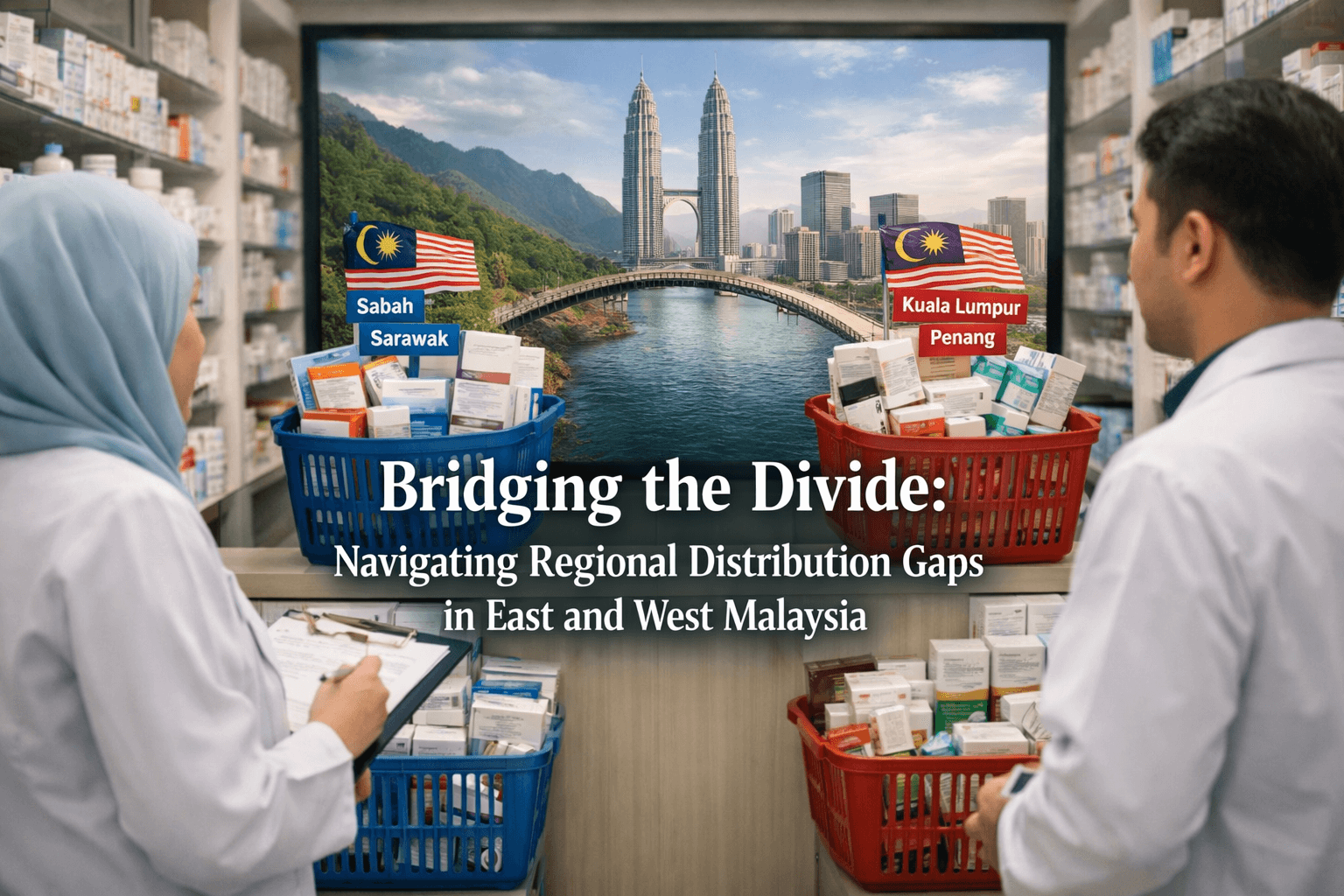
A one-size-fits-all distribution strategy is a recipe for gaps in service and missed opportunities, particularly in a geographically diverse nation like Malaysia. The logistical and service chasm between East and West Malaysia presents a strategic challenge that demands a tailored approach. Pharmacies in Sabah and Sarawak frequently contend with inconsistent wellness stock access due to a confluence of factors: limited transport infrastructure, a scarcity of GDP-certified regional hubs, and extended lead times that complicate inventory management. These challenges are not merely about speed; they encompass the entire supply chain integrity. For instance, maintaining an unbroken cold-chain for premium probiotics or collagen drinks during a multi-day sea and land transit to East Malaysia requires proven logistical expertise and specialized partnerships.
The table below contrasts the common operational scenarios and effective solutions for these distinct regions:
| Aspect | Common Challenge in East Malaysia / Rural Areas | Strategic Solution for Reliable Distribution |
|---|---|---|
| Lead Time & Frequency | Extended, less frequent delivery cycles (5-7 days). | Partner with distributors using strategic regional depots in Kota Kinabalu or Kuching to shorten last-mile delivery. |
| Cold-Chain Integrity | High risk of breakage during long transit, compromising product efficacy. | Select partners with GDP-compliant, temperature-validated logistics and real-time monitoring for sensitive SKUs. |
| Merchandising & Support | Minimal to no in-store support due to distance from central teams. | Utilize independent distributors with localized, embedded merchandisers who understand the local pharmacy landscape. |
| Regulatory Coordination | Slower physical document flow and site audits can delay processes. | Work with distributors who have expert, digitized compliance systems to manage NPRA and KKM submissions efficiently remotely. |
Smart brands address these gaps not by forcing a Peninsular-focused model to work, but by intentionally partnering with regionally anchored distributors. A brand specializing in traditional herbal supplements (jamu), for example, might partner with a distributor like UNIMEDIC Healthcare, which has proven coverage in East Malaysia, to ensure reliable stock flow and cultural relevance in their market approach. This strategy meets the essential service-level expectations of pharmacists in these regions, who value partners that understand and can reliably serve their unique operational constraints.
A Framework for Partner Selection: Aligning Brand Goals with Distributor Capabilities

Selecting the most compatible distribution partner is a strategic decision that will define a brand’s trajectory in Malaysia. The process should be a deliberate matching exercise, aligning specific brand needs with the proven strengths of a distributor. A helpful framework for evaluation focuses on four critical pillars:
Compliance and Regulatory Mastery: Investigate the distributor’s compliance history. Request details on recent audits, their NPRA notification success rate, and the structure of their internal quality team. This is non-negotiable for brand equity protection.
Market Access and Channel Focus: Determine their penetration and relationship strength in your target channels. Do they have effective reach into major chains like Watsons and Guardian, or is their expertise in servicing independent pharmacy networks? Your channel strategy dictates the ideal partner.
Category Expertise and Portfolio Synergy: Assess their existing portfolio. A distributor specializing in sports nutrition, like Pharma Ace, will have a different trade network and consumer insight than one focused on general wellness or beauty-from-within vitamins, like Kino Biotech. Alignment here ensures your brand gets dedicated attention.
Operational Excellence and Reach: Scrutinize their logistics infrastructure and service levels. Can they provide efficient, frequent deliveries to urban Klang Valley pharmacies while also maintaining a reliable schedule for outlets in Kelantan or Pahang? Transparent KPIs on delivery times and order fill rates are key.
This framework moves the selection process beyond price negotiations to a holistic assessment of strategic fit. For a brand with a complex, temperature-sensitive product, the primary filter will be GDP warehouse capability and cold-chain logistics. For a brand launching a major integrated marketing campaign, the distributor’s merchandising support and ability to execute nationwide retail activations will be the deciding factor.
Building Sustainable Growth Through Integrated Partnership

Ultimately, navigating the Malaysian vitamin and wellness landscape culminates in recognizing that distribution is far more than a cost center or a shipping contract. It is a strategic, integrated partnership that collectively drives the core commercial pillars of visibility, availability, and credibility. A trusted distributor functions as an extension of your team, safeguarding your regulatory standing, amplifying your marketing investment at the point of sale, and ensuring your product is consistently within reach of the conscious consumer, from the heart of Kuala Lumpur to the communities of Sandakan. The journey from product concept to pharmacy shelf is intricate, woven through with regulatory, logistical, and commercial threads. The right partner doesn’t just manage these threads—they weave them into a cohesive and reliable route to market, building long-term value for brands, supporting the professional goals of pharmacists, and, most importantly, ensuring safe and accessible wellness products for all Malaysians.
How can we assist you today? 😊
Just let us know—we’re here to help!