December 29, 2025
Learn more : Technology & Digital Tools Enhancing Modern Merchandising Execution
Learn more : The Impact of Lighting, Layout, and Store Design on Pharmacy Merchandising in Malaysia
Learn more : Why Your Pharmacy Needs a Merchandising Service Partner

The integration of product placement, store layout, and promotional display creates a synergistic effect that directly and measurably boosts a pharmacy’s commercial health. This isn’t theoretical; it’s a proven commercial reality. When executed with strategic precision, these pillars work in concert to maximize sales, prevent costly out-of-stock situations, ensure efficient stock rotation to minimize expired goods, and protect profit margins. This holistic approach to merchandising is what transforms a passive retail space into an active commercial engine, directly supporting the value proposition of a full-service pharmacy distribution service in Malaysia. The impact, however, manifests differently across the country’s diverse retail landscapes. In a high-volume urban store in Kuala Lumpur, the primary focus is on attractiveness and impulse generation, using bold displays and strategic sightlines to capture the attention of a time-poor, spoilt-for-choice consumer. Conversely, in a rural pharmacy in East Malaysia, the emphasis shifts dramatically to accessibility and clarity, where a logical layout and clear product zoning ensure that essential medicines and basic healthcare items are easy to find for a community that may have fewer alternatives.
The performance of these merchandising efforts is quantifiable through key retail KPIs. A well-merchandised store will see a marked improvement in its sell-through rate (the percentage of inventory sold in a period), a higher capture rate (converting browsers into buyers), optimized customer pathing (the route shoppers take), and near-perfect planogram compliance. These metrics move the needle on the bottom line. For instance, a strategic promotional display for a new vitamin brand can double its sell-through rate in a single month, while poor product placement leading to frequent out-of-stocks can erode customer trust and send them to a competitor permanently.
Table: Key Performance Indicators Before vs After Improved Merchandising Execution
| Key Performance Indicator (KPI) | Scenario Before Improved Merchandising | Scenario After Improved Merchandising |
|---|---|---|
| Sell-Through Rate | Low movement on high-margin OTC items and new product launches. | Significant increase in sales velocity for strategically placed and promoted products. |
| Out-of-Stock (OOS) Incidence | Frequent gaps on shelves for key SKUs, leading to lost sales. | Drastic reduction due to systematic replenishment and better inventory visibility. |
| Customer Dwell Time | Shoppers enter, grab one item, and proceed to checkout quickly. | Increased time spent browsing, leading to higher basket size and discovery of new products. |
| Planogram Compliance | Inconsistent shelf sets, incorrect facings, and poor category zoning. | High adherence to the planned layout, ensuring a consistent, reliable shopping experience. |
Learn more : Shopper Behavior Trends
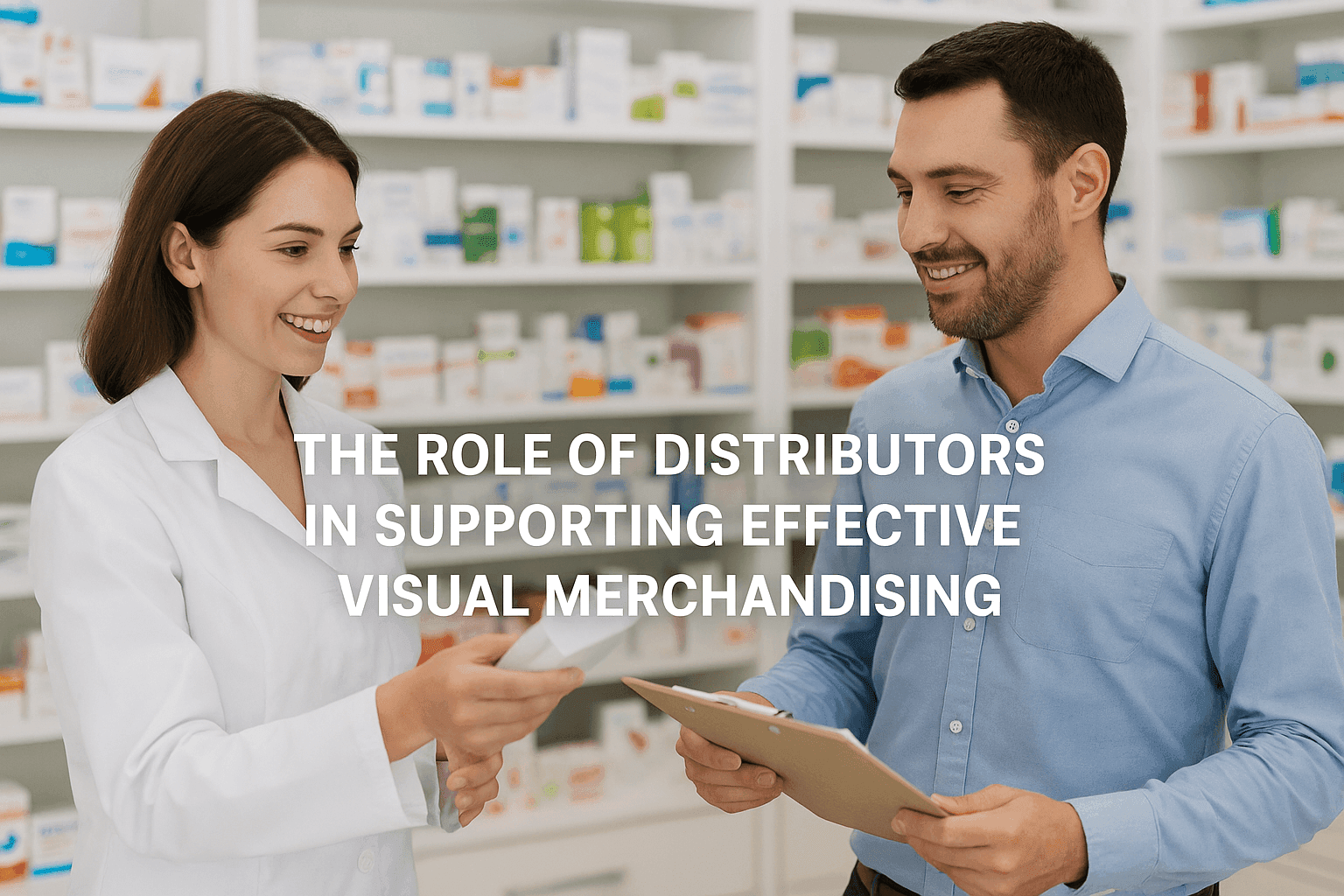
For most pharmacies, especially independent ones, the consistent execution of these three pillars is not a solo mission but a collaborative effort with a trusted distributor pharmacy partner. Pharmacies heavily depend on these expert field teams to translate strategy into tangible shelf-level reality. The responsibilities of these teams are extensive and critical; they conduct detailed stock checks during each visit, perform replenishment to fill gaps, build and refresh promotional displays, install point-of-sale materials (POSM), and provide audit reporting that gives brands and pharmacists a clear picture of in-store conditions. An independent pharmacy distributor partner is particularly essential for maintaining brand consistency and merchandising standards across a network of disparate outlets, acting as the extended arm of both the brand and the pharmacist.
The value provided extends far beyond simple product delivery. Top-tier pharma distributors offer value-added services that elevate the entire retail operation. This includes training store staff on new products, providing briefings on upcoming A&P (Advertising & Promotion) activations, and sharing market intelligence that helps the pharmacy stay ahead of trends.
From the Pharmacist’s Perspective: This support translates to a significantly reduced workload. It allows the pharmacist to focus on their core professional duties—patient consultation and prescription management—without being overwhelmed by the constant demands of shelf management and display building.
From the Distributor’s Perspective: The challenge lies in efficient route planning and flawless execution. Their success is measured by their ability to service multiple pharmacies on a tight schedule while ensuring every task, from stock rotation to display setup, is completed to the highest standard.
From the Brand Manager’s Perspective: The distributor is the guarantor of consistent brand visibility. They ensure that the marketing investment made in creating a promotional campaign is fully realized at the point of sale, which is the moment of truth for any consumer brand.
Learn more : Reimagining Last-Mile Delivery
In the Malaysian healthcare retail environment, visual merchandising operates within a strict and non-negotiable regulatory framework. It is essential that all in-store product placement and promotional activities fully comply with guidelines set by the National Pharmaceutical Regulatory Agency (NPRA), the Ministry of Health (KKM), and Good Distribution Practice (GDP) standards. This strategic alignment is as important as any commercial consideration. There are specific restrictions on the claims that can be made for certain product categories, particularly for health devices and supplements. A display must never mislead consumers, create confusion between prescribed and over-the-counter medicines, or bypass regulatory requirements—for example, by placing a general health product next to a prescription-only medicine in a way that implies similar efficacy.
The risks for pharmacies that ignore these rules are severe, ranging from warnings and fines to more serious regulatory action from the NPRA. The role of a pharmacy distributor Malaysia wide is crucial in acting as a first line of defense against compliance breaches. Their trained merchandisers understand the boundaries and can ensure that promotional materials and product placements are not just commercially attractive but also fully compliant with local regulations, thereby protecting the pharmacy’s trusted reputation.
Table: Compliant vs Non-Compliant Promotional Materials in Malaysian Pharmacies
| Element | Compliant Example | Non-Compliant Example (Risk) |
|---|---|---|
| Health Claims | A poster for a vitamin C supplement stating: “Helps support the immune system.” | A poster claiming: “Cures and prevents flu and colds.” (Unapproved therapeutic claim) |
| Product Placement | Creating a “Wellness” zone with vitamins and supplements, clearly separated from the OTC medicine section. | Placing a blood pressure monitor directly next to prescription heart medication, implying a diagnostic link. |
| Point-of-Sale Materials | Using branded posters that focus on the product name and lifestyle imagery, with approved, general benefit statements. | Using materials that feature fake doctor endorsements or misleading before-and-after graphics. |
Learn more : NPRA Regulatory Framework

The execution of merchandising strategies has been revolutionized by digital tools, making the entire process more efficient, accurate, and accountable. Merchandising audits that once relied on paper checklists are now conducted through intuitive mobile applications. These platforms enable photo reporting with geotagging, providing irrefutable proof of execution. GPS tracking allows for optimized route management for distributor teams, while real-time shelf checks can be fed back to brand managers, offering an immediate pulse on stock levels and competitor activity. Emerging technologies like AI planogram validation can analyze shelf images to automatically measure compliance, identifying gaps or misplaced items with incredible speed.
Pharmacy wholesale distributors are increasingly leveraging these technologies to enhance their service delivery. This digital transformation ensures a higher level of accuracy and accountability in the field. For a brand, this means they can track the rollout of a new product or campaign in near-real-time, ensuring their investment is being properly executed. For the pharmacist, it means their distributor pharmacy partner is using the most effective tools available to maintain a tailored and optimally performing store environment, directly impacting sales and customer satisfaction.
Learn more : The Future of Retail Operations
The journey of a healthcare product is not complete when it leaves the warehouse. Its final and most critical stage unfolds on the shelves of the pharmacy. The strategic integration of product placement, store layout, and promotional display is, therefore, not a matter of cosmetic enhancement but an essential commercial function. These three pillars collectively determine a pharmacy’s ability to move inventory, serve customers effectively, and build a reputable brand. This entire ecosystem is supported by the robust infrastructure of the pharmacy distribution service in Malaysia, which provides the crucial “last-mile execution” that bridges supply and demand. In a market where consumer attention is the ultimate currency, the fundamental equation remains: better strategic visibility, driven by proven merchandising principles, directly translates to better sales, unwavering compliance, and deeper customer trust.
Q1: What are the key elements of visual merchandising?
Answer: The key elements include store layout, product presentation, color coordination, lighting, signage, theme consistency, and customer flow management. These elements work together to attract attention, guide shoppers, and increase product visibility.
Q2: What are the 4 elements of merchandising?
Answer: The four elements are Product, Price, Place, and Promotion. These determine how merchandise is selected, priced, displayed, and communicated to customers.
Q3: What are the four most important elements in visual merchandising (VM)?
Answer: The four most important VM elements are Color, Lighting, Space/Layout, and Product Display Techniques. These directly influence customer engagement and buying behavior.
Q4: What are the 7 elements of the merchandise planning process?
Answer: The seven elements are Sales forecasting, Assortment planning, Inventory control, Open-to-buy management, Pricing strategy, Allocation, and Replenishment planning. These ensure the right products are available at the right time.
Q5: What are the 7 R’s of merchandising?
Answer: The 7 R’s are Right Product, Right Quantity, Right Price, Right Place, Right Time, Right Customer, and Right Promotion—core principles to achieve effective retail execution.
Q6: What are the 7 basic elements of strategic planning?
Answer: They include Vision, Mission, Goals, Strategies, Action Plans, Resources, and Evaluation. These guide long-term business direction and performance measurement.
Q7: What are the 5 P’s of merchandising?
Answer: The 5 P’s are Product, Price, Place, Promotion, and People. These shape how merchandise is managed and how customers interact with it.
Q8: What are the 10 principles of merchandising?
Answer: The 10 principles include Right product, Right place, Right time, Right quantity, Right price, Attractive display, Clear communication, Proper lighting, Customer convenience, and Consistent branding.
Q9: What are VM materials?
Answer: VM materials refer to tools and props used to enhance displays, such as fixtures, mannequins, signages, shelving, POP materials, lighting tools, acrylic risers, decorative props, and backdrops.
Q10: What are the 4Ps of visual merchandising?
Answer: The 4Ps are Presentation, Pricing communication, Promotion, and Placement. These shape how products are shown, priced, highlighted, and positioned in-store.