

December 25, 2025
The pharmacy distribution service in Malaysia is far more than a simple conduit for moving boxes from a warehouse to a store shelf. It is a trusted, essential, and reliable pillar of the nation’s entire healthcare ecosystem. In an environment defined by growing complexity and heightened patient expectations, the efficient flow of pharmaceuticals from manufacturer to end-user is a critical determinant of public health outcomes. This intricate network ensures that a mother in Kuching can find the specific pediatric cough syrup she needs, while a diabetic patient in Alor Setar has consistent access to their insulin. The entire system’s integrity hinges on the strategic capabilities of the pharmacy distributor Malaysia relies on, making it a foundational component that directly influences pharmacy performance, brand reputation, and, most importantly, patient access to vital medicines. Without this robust backbone, the entire retail pharmacy structure would struggle to function, leading to stockouts, medication errors, and a significant erosion of public trust in our healthcare services.

The operational environment for pharmacies in Malaysia is remarkably diverse, and this diversity creates a complex web of distribution needs that must be expertly managed. The landscape is a mix of large chain pharmacies with dozens of outlets, independent community pharmacies that serve specific neighborhoods, and clinic-linked outlets that cater to immediate patient prescriptions. Each of these models presents a unique challenge for a pharmacy wholesale distributor. A major chain requires a centralized delivery system to its regional hubs, demanding large-volume shipments and sophisticated data integration for inventory forecasting. In contrast, an independent pharmacy in a rural area like Kota Belud may need smaller, more frequent deliveries to manage its limited shelf space and working capital. This geographical spread, from the high-density urban centers of the Klang Valley to the more remote regions of East Malaysia, necessitates a tailored logistics approach. Furthermore, the entire system operates within a strict regulatory framework governed by the Ministry of Health (KKM) and the National Pharmaceutical Regulatory Agency (NPRA), which adds layers of compliance to every step of the supply chain. From the pharmacist’s perspective, this means relying on a distributor who understands the shelf-level demand for fast-moving over-the-counter (OTC) products versus slower-moving prescription items. For the distributor, the challenge is achieving route efficiency and delivery accuracy across this fragmented and geographically challenging landscape. For the brand owner, success is measured in SKU penetration and ensuring their products are available and visible across all these different pharmacy types, a goal entirely dependent on a strategic and effective distribution partner.

A high-quality pharmacy distribution service is defined by a suite of interconnected, core functions that go far beyond simple transportation. These functions are what separate a basic logistics provider from a true strategic partner in the healthcare supply chain.
Warehousing and Cold-Chain Integrity
The journey begins at the warehouse, which acts as the central nervous system for the entire operation. Modern pharmaceutical warehousing is not just about storage; it’s about maintaining the product integrity of every single item, from stable tablet formulations to temperature-sensitive biologics. This requires a proven cold-chain management system that is absolutely reliable. For instance, a distributor supplying vaccines to clinics across Penang must have uninterrupted temperature monitoring from the moment the shipment leaves the main warehouse until it is received and signed for at the clinic. Any deviation can render a entire batch of costly and life-saving medicines useless, representing a significant financial loss and, more critically, a public health risk. This is a non-negotiable aspect of pharmaceutical logistics that requires expert handling and robust, auditable processes.
Stock Accuracy and Inventory Turnover
Within the warehouse, stock accuracy is paramount. A discrepancy between the digital inventory record and the physical stock on the shelves can lead to a cascade of problems, including incorrect order fulfillment, frustrated pharmacists, and ultimately, stockouts for patients. Advanced distributors employ warehouse management systems (WMS) that utilize barcode or RFID scanning to ensure near-perfect accuracy. This directly supports healthy inventory turnover, a key financial metric for both the distributor and the pharmacy. High turnover indicates that products are moving quickly and not becoming obsolete, which improves cash flow for the pharmacy and reduces the risk of holding expired stock. For a Malaysian independent pharmacy, this means they can operate with a leaner inventory, freeing up capital for other business investments while still maintaining high service levels because they trust their distributor to replenish stock promptly.
Order Fulfillment and Proactive Replenishment
The order fulfillment process is the most visible interaction between a pharmacy and its distributor. It encompasses everything from the moment an order is placed—whether via a digital portal, email, or a traditional sales representative—to its accurate picking, packing, and dispatch. However, leading distributors are moving beyond reactive order-taking to proactive replenishment. By analyzing a pharmacy’s historical sales data and factoring in seasonal trends (like higher demand for flu medication during the monsoon season), they can provide data-driven forecasting. This helps pharmacies avoid the twin pitfalls of overstocking and understocking. A practical implication for a chain pharmacy in Malaysia would be receiving a suggested order that automatically increases the quantity of antihistamines ahead of the haze season, a small but effective adjustment that prevents lost sales and maintains customer satisfaction.
Compliance with KKM and NPRA Mandates
In Malaysia, the role of a distributor is deeply intertwined with regulatory compliance. The KKM and NPRA set stringent guidelines for every aspect of regulated medicines distribution. This includes ensuring all products have valid product notification status, that the distributor itself holds the correct license for wholesale, and that full batch traceability is maintained from manufacturer to point of sale. This is crucial for patient safety, enabling swift and accurate recalls if a product defect is identified. A distributor’s compliance framework is not just a legal requirement; it is a marker of its reliability and commitment to public health. The risks of using non-compliant or grey-market distributors are severe, including the sale of unregistered, counterfeit, or substandard medicines that can have dangerous consequences for patients.
Comparison of Standard vs. High-Compliance Pharmacy Distributors
| Performance Metric | Standard Distributor | High-Compliance Distributor |
|---|---|---|
| Order Accuracy | May have occasional discrepancies; relies on manual checks. | Achieves near 100% accuracy via integrated WMS and barcode scanning. |
| Response Time to Queries | Can be slow; communication channels may not be integrated. | Offers dedicated account support and a proven track record of quick resolution. |
| Regulatory Documentation | Provides basic documentation, may require follow-up. | Automatically provides complete and auditable paperwork for KKM/NPRA. |
| Cold-Chain Management | May use basic coolers with limited temperature monitoring. | Uses certified equipment with real-time, GPS-enabled temperature logging. |
Learn more : Retail Merchandising Services Malaysia

The efficiency of the pharmacy distribution service in Malaysia has a direct and measurable impact on the day-to-day performance of a retail pharmacy and, by extension, the health outcomes of its customers. When the supply chain functions optimally, it creates a virtuous cycle of efficiency and satisfaction.
Ensuring Product Availability and Reducing Stockouts
The most immediate impact is on product availability. A reliable distributor ensures that fast-moving OTC products like painkillers, vitamins, and common skincare items are consistently in stock. For a pharmacy, an out-of-stock (OOS) incident for a high-demand product doesn’t just mean a lost sale; it can damage the pharmacy’s reputation and push a customer to a competitor, potentially permanently. Consider a scenario during a dengue outbreak; the ability of pharmacies across Selangor to maintain supplies of mosquito repellent and paracetamol is directly tied to the distributor’s capacity for rapid replenishment and strategic inventory allocation. Efficient distribution directly reduces the frequency and duration of OOS incidents, which is essential for maintaining pharmacy revenue and customer loyalty.
Optimizing Pharmacist Workflow and Enhancing Patient Satisfaction
From the pharmacist’s perspective, a dependable distribution partner transforms their daily workflow. Instead of spending valuable time manually tracking orders, managing inventory discrepancies, and calling distributors to resolve issues, they can focus on their clinical roles: conducting medication therapy adherence reviews (MTAC), providing patient consultations, and managing chronic diseases. This shift from administrative tasks to professional healthcare services significantly enhances patient satisfaction. A patient who receives their medication quickly and can have a meaningful consultation with an unhurried pharmacist is far more likely to adhere to their treatment and develop a long-term trust in that pharmacy. For the distributor, this translates into more predictable and streamlined delivery cycles, as they are dealing with a pharmacy team that is not in a constant state of fire-fighting supply issues.
Driving Brand Visibility and Sales Velocity
For brand managers and manufacturers, the distributor is the engine that drives their product’s market presence. A strategic distribution partner does more than just deliver goods; they provide valuable market intelligence on SKU performance across different regions and pharmacy types. They ensure that new product launches reach the shelves on time and that promotional materials are distributed alongside the products. For example, when a local Malaysian health brand launches a new herbal supplement, its success in capturing market share from established brands depends entirely on the distributor’s ability to achieve deep and broad penetration into both chain and independent pharmacies. Strong last-mile pharmaceutical logistics ensure the product is not just available, but also visible and actively moving, creating a powerful feedback loop where strong sales convince more pharmacies to carry the product.
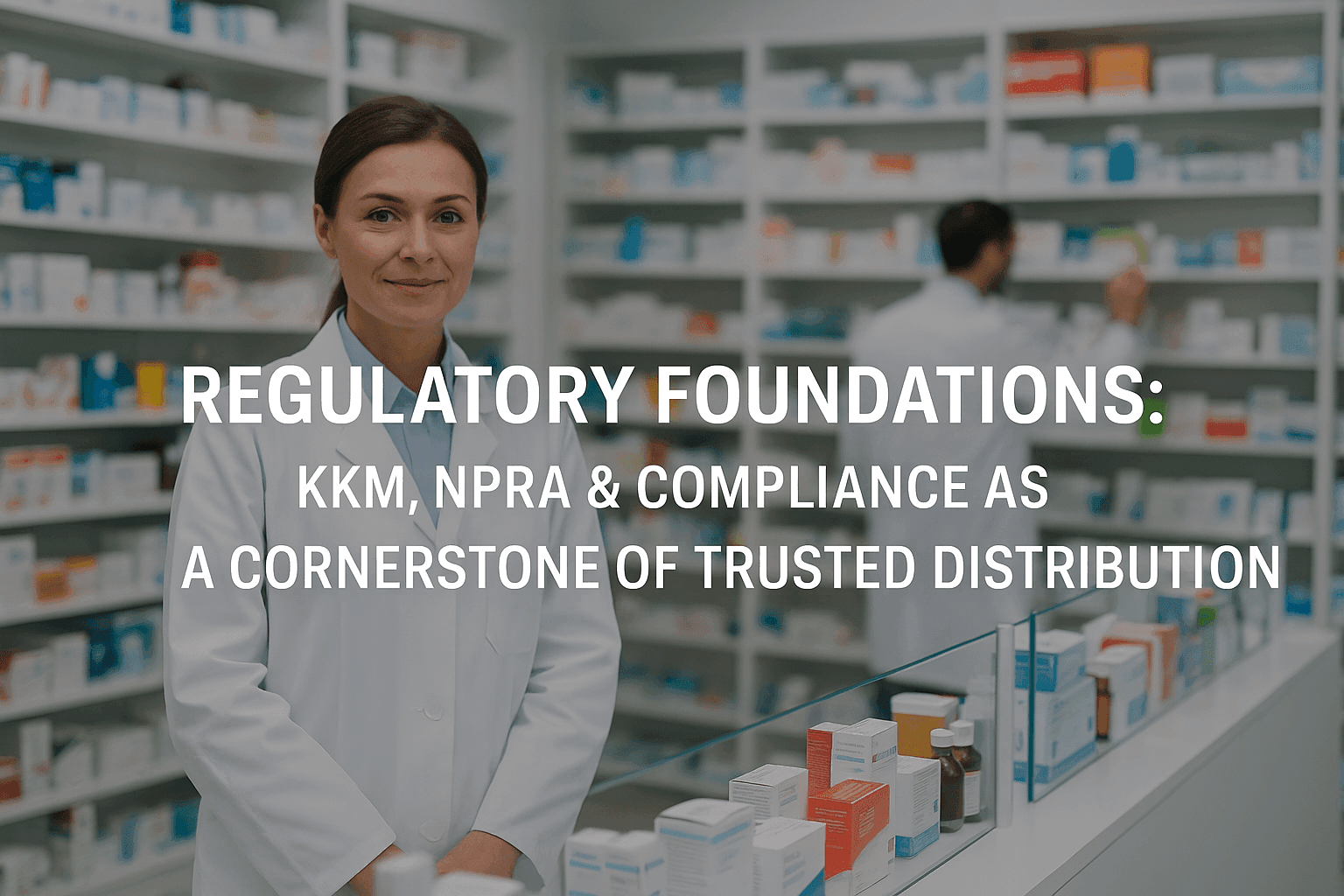
The pharmaceutical supply chain in Malaysia is one of the most heavily regulated sectors, and for a very good reason: it deals directly with public health and safety. The Ministry of Health (KKM) and the National Pharmaceutical Regulatory Agency (NPRA) are the central bodies that enforce a comprehensive framework designed to ensure that every medicine reaching a patient is safe, effective, and of high quality. For a pharmacy distributor Malaysia, compliance is not a side function; it is the very bedrock of their operational license and their claim to being a trusted partner.
The regulatory obligations begin with product notification, where every pharmaceutical product must be registered with the NPRA before it can be imported, distributed, or sold. Distributors are legally required to handle only registered products. Furthermore, they must operate with a valid wholesale license that is subject to regular and rigorous inspections by KKM officers. A critical component of this is batch traceability. This means maintaining meticulous records that allow any product batch to be traced from the manufacturer, through the distributor, and all the way to the specific pharmacy or hospital that received it. This system is essential for executing a swift and precise product recall if a quality defect is discovered post-market, thereby protecting the population from potential harm.
From the compliance officer’s viewpoint within a distribution company, this means implementing a quality management system that leaves no room for error. Every procedure, from goods receipt to dispatch, must be documented and auditable. For the pharmacist, the assurance that their distributor is fully compliant means they can dispense medicines with confidence, knowing they are sourced from a legitimate and regulated channel. They receive the necessary documentation, including the controlled drug registers if applicable, to satisfy their own regulatory audits. For the brand manager, partnering with a compliant distributor is the only way to protect the integrity of their brand and avoid the severe reputational and legal damage associated with their products entering the grey market.
Essential Compliance Checklist for Pharmaceutical Distribution in Malaysia
Licensing: Hold a valid Wholesale License from the KKM specific to the types of medicines being handled.
Product Verification: System in place to verify the NPRA registration status of every product prior to procurement.
Premises Standards: Maintain warehouse facilities that meet GSP (Good Storage Practice) guidelines, including appropriate temperature and humidity control.
Documentation & Traceability: Implement a system that guarantees full batch traceability from receipt to supply, with records retained for the required period.
Personnel Training: Ensure all staff handling medicines are adequately trained in GSP and relevant regulatory requirements.
Cold-Chain Management: For temperature-sensitive products, use validated cold chain equipment and continuous temperature monitoring devices.
Adverse Event Reporting: Have a clear process for identifying and reporting any suspected adverse events or product quality complaints to the NPRA.
The risks of non-compliance are profound. Distributors operating outside this framework pose a significant threat to public health by potentially introducing unregistered, counterfeit, or improperly stored medicines into the market. For pharmacies, sourcing from such entities not only carries legal penalties but also shatters the hard-earned trust of their patients. Therefore, the choice of a distribution partner is, at its core, a commitment to regulatory adherence and patient safety, making it one of the most strategic decisions a pharmacy or brand can make.
Learn more : Good Storage & Distribution Practices

A truly efficient pharmaceutical supply chain in Malaysia is not a series of isolated transactions but a deeply interconnected ecosystem where distributors, pharmacies, and brand owners function as a unified team. This strategic collaboration moves beyond basic logistics to create a synergistic partnership that drives market growth, enhances patient care, and optimizes operational performance for all entities involved. When these three pillars work in concert, they can anticipate market shifts, respond to consumer needs with agility, and ensure that the right products are available at the right time, in the right place. This level of integration is what separates a basic supplier relationship from a tailored partnership that actively contributes to business success. The most effective collaborations are built on a foundation of transparent communication and shared data, transforming the supply chain from a cost center into a strategic asset.
Shared Forecasting and Promotional Alignment
The cornerstone of this collaborative model is shared forecasting and promotional planning. When a major brand owner plans a national launch for a new diabetic supplement, its success hinges on the distributor’s ability to align warehouse stocking with the marketing campaign’s rollout. The distributor, in turn, relies on pharmacies to provide realistic demand forecasts based on their patient demographics. For example, a pharmacy chain with a strong presence in aging-population states like Perak would forecast higher demand, allowing the distributor to pre-allocate stock to their regional hubs. This prevents the all-too-common scenario where a heavily advertised product is unavailable on shelves, which damages brand credibility, frustrates pharmacists, and disappoints patients. A proven collaborative framework ensures that inventory levels across the entire network are synchronized with market activation activities, creating a seamless flow from manufacturer to end-consumer.
Leveraging Consumer Insights and Feedback
Pharmacists are on the frontline of healthcare, granting them unparalleled access to real-time consumer insights and feedback. A collaborative distributor acts as a crucial conduit, channeling this valuable information back to brand owners. An independent pharmacy in Johor Bahru might notice a growing patient preference for sugar-free pediatric antibiotics. By sharing this observation through their distributor’s field team or digital portal, the information can be aggregated and presented to the brand manager. This can influence future product development, packaging changes, or targeted marketing strategies. From the brand manager’s perspective, this direct line to the point of care is invaluable market intelligence that no focus group can replicate. For the pharmacist, it fosters a sense of partnership, knowing their expert observations contribute to the broader healthcare landscape. This feedback loop turns every pharmacy outlet into a sensor for market trends, making the entire supply chain more responsive and intelligent.
Visual Merchandising and Category Management Collaboration
The final touchpoint of collaboration occurs right at the pharmacy shelf through visual merchandising (VM) and category management. A full-service distributor offers more than just product delivery; they provide expert support in planning and executing high-impact displays that drive sales for specific categories. Consider the cough and cold category during the year-end monsoon season. A strategic partner would work with both the brand owner, who may provide promotional materials, and the pharmacy manager to create a dedicated end-cap or gondola display. This coordinated effort ensures maximum visibility for high-demand products, which directly improves sell-through rates. For the pharmacist, this support is a significant value-add, as it enhances store aesthetics and optimizes sales per square foot without burdening their own staff. For the brand owner, it guarantees that their marketing investments are fully realized at the critical point of purchase. This three-way collaboration on VM turns the pharmacy floor into a dynamic commercial landscape that benefits all stakeholders.

The digital revolution is fundamentally reshaping the landscape of pharmacy distribution service in Malaysia, introducing unprecedented levels of efficiency, accuracy, and transparency. Legacy systems reliant on phone calls, paper invoices, and manual stock counts are rapidly giving way to integrated digital platforms that create a seamless flow of information parallel to the physical flow of goods. This transformation is not merely a convenience; it is an essential evolution to meet the growing complexities of the Malaysian market. Digital pharmacy logistics platforms empower every stakeholder with real-time data, from the warehouse manager overseeing automated picking systems to the community pharmacist placing an order via a cloud-based portal on their mobile device. This technological leap is the bedrock of a modern, reliable, and efficient supply chain capable of supporting the future of healthcare in the country.
Digital Inventory and Ordering Platforms
At the heart of this transformation are cloud-based inventory and ordering platforms. These systems provide pharmacists with 24/7 access to a distributor’s live stock levels, allowing for accurate, real-time ordering that drastically reduces the errors associated with manual entry. A pharmacist in Kuantan can check stock, place an order, and receive a confirmed delivery time slot within minutes, all from a single dashboard. This capability is particularly effective for managing inventory turnover and preventing stockouts of critical items. Furthermore, these platforms often feature data analytics modules that provide insights into sales trends, helping pharmacies make smarter purchasing decisions. The practical implication is a more streamlined back-office operation for the pharmacy, freeing up the pharmacist’s time for patient-facing care, while providing the distributor with a predictable and efficiently managed order flow.
AI-Powered Forecasting and Route Optimization
Advanced distributors are now leveraging Artificial Intelligence (AI) and machine learning to move from reactive operations to predictive supply chain management. AI algorithms can analyze vast datasets—including historical sales, seasonal disease patterns, local events, and even weather forecasts—to generate highly accurate demand predictions. For instance, a system might proactively flag an increased need for asthma medication in Selangor ahead of a forecasted haze period, prompting both the distributor to stock up and pharmacies to review their inventory. On the logistics front, AI-driven route planning software dynamically optimizes delivery routes in real-time, accounting for Kuala Lumpur’s notorious traffic congestion. This ensures the most efficient delivery schedules, reduces fuel costs, and guarantees that temperature-sensitive products spend minimal time in transit, upholding the integrity of the cold chain. This is a proven approach to enhancing last-mile delivery reliability.
Real-Time Tracking and Supply Chain Visibility
The expectation for visibility, similar to what consumers experience with parcel delivery, is now becoming standard in pharmaceutical logistics. Real-time GPS tracking of delivery vehicles allows pharmacies to know the exact location of their orders and receive accurate estimated times of arrival. This transparency allows pharmacy staff to plan their receiving workflow efficiently, minimizing disruption. For temperature-sensitive products, this tracking is integrated with real-time temperature monitoring, creating an auditable log that proves the product was maintained within its required range throughout the journey. This level of visibility is not just a luxury; it is a trusted component of quality assurance, providing all parties with the confidence that products have been handled correctly and are safe for patient use.
Learn more : Understanding the ROI of Pharmacy Merchandising Investments in Malaysia | Digitalized Supply Chains for the Future of Biopharma
The path to a flawless pharmacy distribution service in Malaysia is paved with a unique set of challenges, shaped by the nation’s geography, infrastructure, and regulatory environment. Acknowledging these hurdles is the first step toward developing strategic and reliable solutions that strengthen the entire healthcare supply chain. From congested urban centers to remote rural locations, distributors must navigate a complex landscape while maintaining the high standards of speed, accuracy, and compliance demanded by the pharmaceutical industry. The rising competition from FMCG-style logistics, which often prioritizes speed over regulatory rigor, further intensifies the pressure on pharma distributors to justify their value. However, within each of these challenges lies an opportunity for innovation and partnership.
Geographical Dispersion and Infrastructure Hurdles
The logistical challenge of serving a geographically dispersed market like Malaysia cannot be overstated. Distributing products to a dense network of chain pharmacies in the Klang Valley presents a very different set of problems compared to reaching an independent pharmacy in a rural village in Sarawak, where road conditions and travel times can be significant barriers. The practical implication of this is inconsistent delivery frequencies and higher operational costs for last-mile delivery to remote areas. A strategic solution employed by leading distributors is the implementation of flexible routing models and regional micro-distribution centers. By establishing a smaller hub in East Malaysia, for example, a distributor can consolidate supplies and optimize local delivery routes, ensuring more reliable and frequent service to pharmacies in Borneo without the cost and delay of shipping every order from the peninsula.
Regulatory Complexity and SKU Proliferation
The Malaysian pharmaceutical market is characterized by a stringent regulatory framework and an ever-expanding array of products, or SKU proliferation. Navigating KKM and NPRA requirements for product registration, import licenses, and batch documentation requires expert knowledge and meticulous attention to detail. Simultaneously, distributors and pharmacies are faced with an overwhelming number of SKUs to manage, from innovative biologics to a vast range of generic medicines and OTC products. This creates significant cost pressures and operational complexity. The remedy lies in tailored technology solutions and proven processes. Distributors can offer value by providing clear compliance guidance and documentation support to their pharmacy partners. Furthermore, implementing advanced warehouse management systems (WMS) is essential for maintaining accuracy and efficiency in picking and packing a vast and diverse product catalogue, ensuring that the right product reaches the right pharmacy without error.
Rising Costs and FMCG Competition
Pharmacies today face pressure from all sides, including competition from non-traditional channels that may operate with different standards. The challenge for professional pharmaceutical distributors is to demonstrate that their services provide a value that far exceeds that of a simple cargo delivery service. This involves articulating and delivering on the critical differentiators: regulatory compliance, cold-chain integrity, product expertise, and merchandising support. The effective solution is a shift in perspective—from being a vendor to becoming an essential strategic partner. By providing data analytics that help pharmacies optimize their inventory and increase profitability, or by offering merchandising services that enhance sales, a distributor justifies its role as an indispensable part of the pharmacy’s success, far beyond the capabilities of a standard logistics provider.
Comparison of Distributor Types for Malaysian Pharmacies
| Evaluation Criteria | Conventional Distributor | GMP-Compliant Distributor | Full-Service Distributor |
|---|---|---|---|
| Core Focus | Cost and speed of delivery. | Regulatory adherence and product safety. | End-to-end partnership and business growth. |
| Compliance & Documentation | Basic; may lack robust systems. | Expert; full compliance with KKM/NPRA, with auditable batch traceability. | Trusted; exceeds compliance, provides proactive documentation support. |
| Value-Added Services | Minimal to none. | Basic inventory reporting. | Strategic merchandising, tailored data insights, and promotional support. |
| Ideal For | Low-risk, non-essential OTC goods. | Reliable supply of prescription and temperature-sensitive medicines. | Pharmacies seeking a strategic partner for long-term growth and market competitiveness. |
Learn more : Digital Transformation in Global Supply Chains
Selecting a pharmacy distributor Malaysia is one of the most consequential decisions a pharmacy owner or manager will make. This choice directly impacts daily operations, regulatory standing, financial health, and ultimately, patient satisfaction. The selection process should therefore be treated with the utmost diligence, moving beyond price comparisons to a holistic evaluation of capability, reliability, and strategic alignment. An effective partner functions as an extension of the pharmacy’s own team, providing a trusted foundation upon which the business can grow and thrive. The goal is to identify a distributor whose strengths complement the pharmacy’s needs, whether it’s a large chain requiring sophisticated EDI integration or an independent community pharmacy seeking personalized service and flexible terms.
Foundational Compliance and Capacity
The non-negotiable starting point is a demonstrable and unwavering commitment to regulatory compliance. Any potential distributor must be fully licensed by the KKM and possess a proven track record of adhering to NPRA guidelines. Pharmacies should verify licenses and ask for details on their quality management systems. Equally important is assessing the distributor’s physical and operational capacity. This includes evaluating the size and technological sophistication of their warehouse, the condition and capability of their cold-chain infrastructure, and their fleet’s ability to deliver to the pharmacy’s location consistently. A distributor’s capacity is a direct reflection of their reliability; a lack of investment in modern infrastructure is a significant red flag for future service delivery.
Service Consistency and Communication Quality
In the dynamic environment of a pharmacy, consistency is king. Erratic delivery times, frequent order errors, and fluctuating product quality create operational chaos. When evaluating a partner, pharmacies must scrutinize their historical performance on order accuracy and on-time delivery rates. Transparent reporting that provides clear insights into these metrics is a hallmark of a professional organization. Furthermore, the quality of communication is paramount. Is there a dedicated account manager or a responsive support channel? When a problem arises—such as a short-dated product or a missing item—the ability to resolve it quickly and effectively is critical. An expert distributor views clear communication not as an added feature but as an essential component of their service.
Value-Added Support and Strategic Alignment
Finally, the pharmacy should consider the potential for a strategic partnership. Does the distributor offer services that can help the pharmacy grow? This is where a full-service distributor truly differentiates itself. Capabilities such as professional merchandising support, detailed sales analytics reports, and collaboration on product launch plans provide immense value. For a Malaysian pharmacy looking to expand its front-of-shop OTC business, a distributor with a strong visual merchandising team can be a game-changer. The right partner understands the local market dynamics and can provide tailored advice on category management, helping the pharmacy optimize its shelf space for maximum profitability and patient convenience.
Learn more : Choosing the Right Distributor Pharmacy for Your Business Needs
The trajectory of pharmacy distribution service in Malaysia points toward a future of greater integration, intelligence, and specialization. As the healthcare landscape evolves with industry growth, the advent of more complex biologics and specialized therapies, and an increasingly discerning patient population, the demands on the supply chain will only intensify. The role of the distributor will expand from a logistics provider to an essential data-driven partner, central to the success of both pharmacies and brand owners. The continued digital transformation of the sector will further enhance transparency and efficiency, with technologies like blockchain for enhanced batch traceability and the Internet of Things (IoT) for smarter asset monitoring becoming more commonplace. In this future, the most successful players will be those who have invested not only in technology but also in building strategic, collaborative relationships. The proven ability to deliver a reliable, compliant, and value-added service will be the defining characteristic of a trusted distribution partner, solidifying their role as a cornerstone of Malaysia’s healthcare ecosystem.
Learn more : Good Distribution Practice: Key Principles
Q1: What is visual merchandising in retail?
Answer:
Visual merchandising is the practice of designing and arranging store displays, products, lighting, and layout to attract customers, enhance the shopping experience, and increase sales.
Q2: Which definition refers to visual merchandising?
Answer:
Visual merchandising refers to the strategic presentation of products through layout, color, signage, and displays to influence customer behavior and highlight key items.
Q3: What is the definition of retail merchandising?
Answer:
Retail merchandising involves planning, selecting, purchasing, displaying, and promoting products in a retail environment to optimize sales, inventory flow, and customer satisfaction.
Q4: What are the four main elements of visual merchandising?
Answer:
The four main elements are store layout, product display, signage/communication, and lighting—all working together to guide customers and enhance product visibility.
Q5: What are the 4 P’s of visual merchandising?
Answer:
The 4 P’s are Presentation, Pricing, Promotion, and Placement, which collectively shape how products are shown, promoted, and organized in a retail space.
Q6: What are the 7 rules of merchandising?
Answer:
The 7 rules include:
Right product
Right place
Right time
Right quantity
Right price
Right presentation
Right customer targeting
Q7: What are the 4 pillars of merchandising?
Answer:
The four pillars are Product, Placement, Pricing, and Promotion, forming the foundation for effective retail merchandising strategies.
Q8: What is the 80/20 rule in merchandising?
Answer:
The 80/20 rule states that 80% of sales often come from 20% of products, guiding retailers to focus on high-performing SKUs for better profitability and shelf efficiency.
Q9: What are the 5 P’s of merchandising?
Answer:
The 5 P’s are Product, Price, Place, Promotion, and People, emphasizing the human element in driving sales and customer engagement.
Q10: What are the 4 types of merchandise?
Answer:
The four types are Staple merchandise, Fashion merchandise, Seasonal merchandise, and Impulse merchandise, each requiring different planning and display strategies.