

The landscape of pharmaceutical distribution in Malaysia is governed by a non-negotiable truth: product safety and regulatory compliance are the bedrock of a reliable supply chain. For any entity operating within this sphere—from a large-scale importer to a local pharmacy distributor—the process of verifying product registration with the Ministry of Health Malaysia (KKM) is far more than a bureaucratic tick-box exercise. It is, in fact, a essential strategic function that protects public health and fortifies business integrity. The Malaysian pharmaceutical market, valued for its robust growth and increasing complexity, faces persistent challenges, most notably the infiltration of counterfeit and unregistered products. These illicit goods not only endanger patient safety but also erode the trusted relationship between healthcare providers, distributors, and consumers. Therefore, mastering the official verification process through KKM’s digital platforms is a critical competency. It is the primary defence mechanism that ensures only registered and safe products traverse the intricate pathways from warehouse to pharmacy shelf. This proactive approach to compliance is what distinguishes a reputable, reliable partner in healthcare logistics from one that is a liability to the entire ecosystem.
Understanding the Gatekeepers: The Distinct Roles of NPRA and FSQD
To navigate Malaysia’s pharmaceutical regulatory environment effectively, one must first understand its two primary custodians: the National Pharmaceutical Regulatory Agency (NPRA) and the Food Safety and Quality Division (FSQD) . While both operate under the umbrella of the KKM, their jurisdictions are clearly demarcated, forming an expert and efficient framework for product oversight. The NPRA is the authority for all things pharmaceutical. This includes prescription and over-the-counter drugs, as well as traditional products making specific health claims. Their rigorous evaluation process assesses the quality, safety, and efficacy of a product before it can be granted a registration number, a process essential for maintaining the high credibility of the market.
Conversely, the FSQD takes the lead on a broader category of consumables, including food supplements, health foods, and cosmetics. While a cosmetic might not require the same clinical trial data as a pharmaceutical, its compliance with safety standards—such as heavy metal limits and ingredient listings—is strictly enforced by the FSQD. The distinction is critical for a distributor. Misclassifying a product can lead to applying the wrong verification process, potentially resulting in non-compliance. These agencies do not operate in silos; their collaboration creates a seamless regulatory net. For instance, a product might be classified as a “supplement” by the FSQD, but if its marketing materials suggest it treats a disease, it could be reclassified as a pharmaceutical, falling under NPRA’s jurisdiction. This interplay ensures that no product, regardless of its category, slips through the cracks. For a pharmaceutical distributor, understanding this dual structure is the first step in building a strategic compliance protocol.
| Regulatory Body | Primary Jurisdiction | Key Compliance Focus | Example Product |
|---|---|---|---|
| NPRA (National Pharmaceutical Regulatory Agency) | Pharmaceutical products, traditional medicines with health claims | Efficacy, safety, quality, clinical data | Prescription drugs, over-the-counter painkillers |
| FSQD (Food Safety and Quality Division) | Food supplements, health foods, cosmetics | Ingredient safety, heavy metal limits, labelling | Vitamin C tablets, beauty serums, sports drinks |
Learn more: Regulatory Framework for Pharmaceutical Distribution
A Strategic Guide to Mastering the NPRA Portal for Product Verification
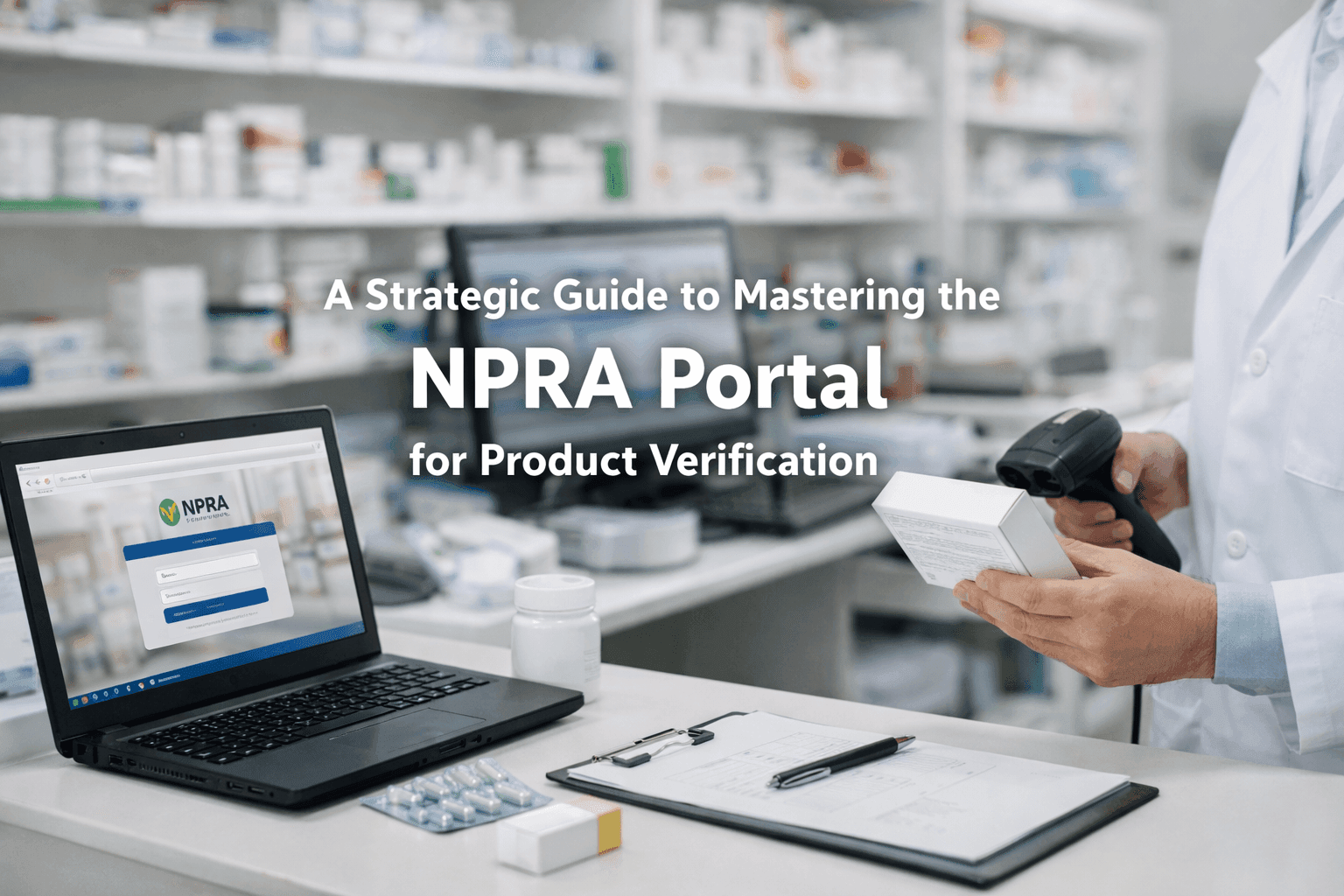
For a pharmacy distributor operating in a fast-paced environment, time is money, and accuracy is paramount. The NPRA’s online portal, specifically the Quest3+ system, is the primary tool for strategic product verification, but its utility depends on knowing how to use it effectively. This is not merely a lookup function; it is a proven method to safeguard your pharmaceutical logistics and pharmaceutical warehousing operations from the risks of non-compliance. The process begins long before a product reaches the warehouse. When a new product is being considered for distribution, the first step is a thorough check on the NPRA portal.
Strategic Verification Checklist for Distributors:
Step 1: Access the Quest3+ System: Navigate to the official NPRA website and access the Quest3+ database. This is the most reliable source for up-to-date registration information.
Step 2: Input Accurate Product Details: Use the product name, registration holder’s name, or the registration number (e.g., MALxxxxxxxxT). A common pitfall is using incomplete or slightly incorrect names. The system is exact, so precision is key.
Step 3: Interpret the Registration Status: The status is the most critical piece of information. A status of “Active” or “Berkuatkuasa” means the product is registered and safe for distribution. Look for the expiry date of the registration as well. A product with an expired registration is legally no different from an unregistered one.
Step 4: Cross-Check Product Details: The portal will display the product’s registered particulars, including the manufacturer, ingredient list, and dosage form. This is a vital step in pharmaceutical warehousing. Before accepting a shipment, verify that the physical product’s packaging and details match exactly what is registered with the NPRA. Discrepancies, such as a different manufacturer address or an unlisted excipient, are red flags that require immediate attention.
From a distributor’s perspective, this verification is not a one-time event. It should be an integral part of the standard operating procedure for inventory intake. Integrating this check into the goods receiving process ensures that only compliant stock enters the supply chain. For a brand manager, this proven process builds confidence that their product is being handled by a partner who values compliance as much as they do. By embedding this strategic step into daily operations, distributors move from a reactive posture—waiting for a problem to occur—to a proactive one, ensuring that every item stored and shipped is unequivocally compliant with KKM standards.
Navigating the FSQD Portal: Ensuring Compliance for Supplements and Cosmetics
The process shifts gears when dealing with products like health supplements, functional foods, and cosmetics. Here, the authority is the Food Safety and Quality Division (FSQD) , and their verification portal is just as crucial for maintaining a tailored and proven compliance framework. For a pharmacy wholesale distributor, the inability to distinguish between an NPRA-registered pharmaceutical and an FSQD-approved supplement can lead to significant compliance gaps. The verification process on the FSQD portal is designed to help you quickly distinguish between a “Produk Lulus KKM” (approved product) and a “Produk Tidak Berdaftar” (unregistered product), a distinction that is absolutely essential for legal distribution.
A common operational scenario in Malaysia involves the distribution of imported health supplements. Consider a distributor bringing in a popular line of Korean ginseng drinks. The first step on the FSQD portal involves searching for the product by its name or the import notification number. The system will return a result indicating its approval status. However, the verification does not stop there. A practical insight from local industry experience is to pay close attention to the product’s label claims. The FSQD approval is for a specific formulation and label. If the distributor or the brand manager decides to run a promotion highlighting a “therapeutic benefit” not listed in the approved FSQD notification—for example, claiming the ginseng drink “improves blood circulation” instead of the approved “helps maintain energy”—the product effectively falls out of compliance. This is a grey area that has tripped up many distributors.
From the perspective of a pharmacist at a retail chain, this verification is their first line of defence. Before accepting a new line of beauty supplements, the pharmacist will often independently verify the product on the FSQD portal. If it doesn’t show up, or if the details don’t match, the shipment is refused. For the distributor, this means that a failed verification at the pharmacy door translates directly into lost revenue and a damaged reputation. Therefore, an efficient and reliable internal process for checking all supplements and cosmetics against the FSQD database before they even leave the warehouse is not just good practice—it is a competitive necessity. It ensures that every product in your portfolio is not just “approved” in theory, but fully compliant in practice, ready for sale across Malaysia’s diverse retail landscape.
The High Cost of Oversight: Implications of Non-Compliance for Distributors
What is the actual fallout when a pharmaceutical distributor fails to ensure KKM compliance? The consequences are severe, multi-faceted, and can threaten the very survival of a business. Distributing a product that is unregistered, or whose registration has lapsed, is a direct violation of the Drugs and Cosmetics Control Regulations 1984. The implications are not merely theoretical; they are a stark reality that has played out in the Malaysian market. Legally, the penalties can be crippling. Companies and individuals face substantial fines and, in serious cases, imprisonment. Beyond the courtroom, the strategic damage is often more profound. The National Pharmaceutical Regulatory Agency (NPRA) has the authority to issue public notifications, naming and shaming companies that distribute unregistered or adulterated products. Once a distributor’s name appears in such a notification, the trusted relationship with pharmacies and consumers is shattered overnight.
Consider a real-world example: a distributor in the Klang Valley was found to have distributed a batch of a popular cough syrup that was not registered with the NPRA. The consequence was an immediate product recall, executed at the distributor’s own expense, costing hundreds of thousands in logistics and lost stock. But the effective cost was higher. Pharmacies that had purchased from them now viewed the distributor as a risk. Their buying committees demanded proof of registration for every single product before future orders, slowing down the entire sales cycle. Some pharmacy chains even delisted all products from that distributor to protect their own compliance standing. This loss of business credibility is a long-term wound.
To mitigate these risks, a proven and strategic approach to compliance is required. The following comparison illustrates how different roles in the supply chain view these risks and the necessary safeguards:
| Stakeholder | Primary Concern Regarding Non-Compliance | Key Safeguard/Action Required |
|---|---|---|
| Pharmacy Distributor | Financial loss from recalls, legal penalties, and de-listing by pharmacies. | Implement pre- and post- shipment verification checks; maintain a dynamic, audited database of compliant products. |
| Brand Manager | Irreparable brand damage, loss of consumer confidence, and market access being revoked. | Ensure all marketing claims align with registered indications; provide distributors with verified product data. |
| Retail Pharmacist | Dispensing unsafe products, legal liability for the pharmacy, and endangering patient health. | Independently verify product status on NPRA/FSQD portals before accepting stock and during random audits. |
For a pharmaceutical distributor, protecting the business requires embedding compliance into the corporate culture. It means moving beyond viewing verification as a simple check and seeing it as an effective, ongoing risk management strategy. Every shipment received, every new product line taken on, must pass through the filter of KKM verification. This diligent, reliable approach is the only way to ensure long-term sustainability in Malaysia’s regulated pharmaceutical market. It transforms compliance from a cost centre into a source of competitive advantage, a badge of honour that signals to all partners—from suppliers to pharmacy chains to the end consumer—that this is a business built on integrity and a commitment to safety.
Learn more: Ensuring Compliance in Pharmaceutical Distribution
How KKM Compliance Affects Pharmacy Distribution Channels in Malaysia
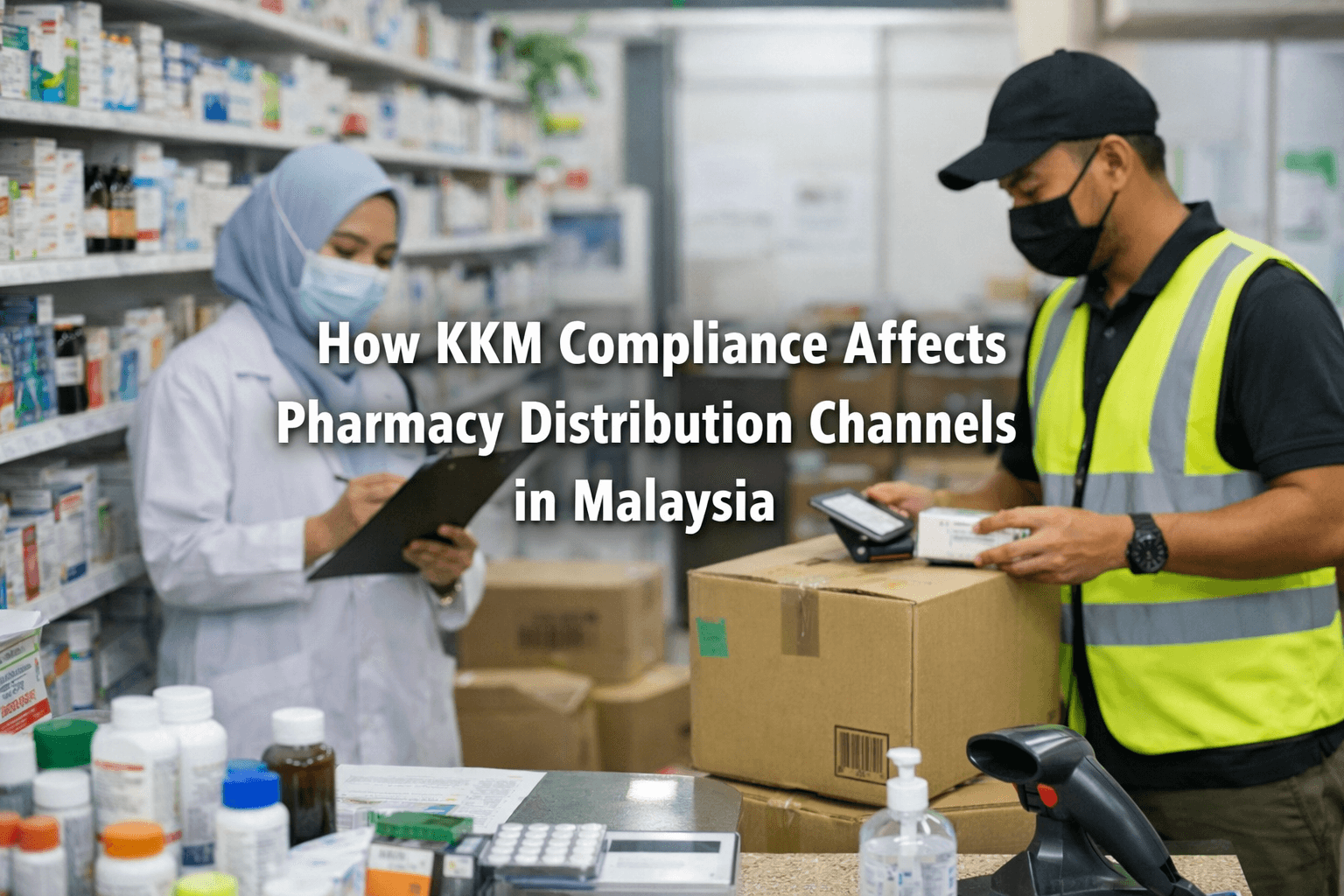
The role of pharmacy distributors extends beyond just checking product registrations. KKM compliance is interwoven into the distribution channels, affecting pharmaceutical warehousing, logistics, and retail relationships in ways that many operators initially underestimate. When you’re moving thousands of products through the supply chain daily, regulatory adherence becomes the essential framework that separates reliable distributors from those constantly firefighting compliance issues.
The Ripple Effect Through Distribution Networks
KKM compliance doesn’t stop at the warehouse door—it permeates every stage of the pharmaceutical journey. For pharmacy distributors in Malaysia, the National Pharmaceutical Regulatory Agency (NPRA) requirements create a cascade of operational adjustments. Temperature-controlled storage isn’t merely about maintaining cold chains; it’s about documenting every temperature fluctuation that could affect product integrity. Logistics partners must demonstrate proven protocols for handling KKM-approved products, ensuring that what leaves the warehouse arrives at retail shelves in perfect condition.
Consider the strategic implications for mid-sized distributors serving Klang Valley pharmacies. When a new pharmaceutical logistics regulation emerges regarding storage humidity levels, it doesn’t just affect the warehouse—it impacts vehicle specifications, delivery scheduling, and even how pharmacists receive products at their counters. The compliance burden, when managed efficiently, becomes a competitive advantage rather than a constraint.
Real-World Impact: The Penang Hospital Supply Chain Case
Take the experience of a Penang-based pharmaceutical distributor servicing both government hospitals and private clinics. During the 2023 regulatory updates to GDP (Good Distribution Practices) standards, they discovered that 15% of their delivery vehicles required immediate retrofitting to meet updated temperature monitoring requirements. Rather than viewing this as a cost centre, they positioned it as an opportunity. Within six months, they secured three new hospital contracts specifically because their reliable compliance infrastructure exceeded competitor capabilities.
This real-world example demonstrates how KKM compliance, when treated as operational infrastructure rather than paperwork, transforms distribution channels. Pharmacists increasingly ask distributors about their proven compliance record before committing to long-term supply agreements. The trust factor, built through consistent regulatory adherence, directly influences retail relationships.
Data-Driven Compliance: Numbers That Matter
According to NPRA enforcement data from 2022 to 2024, approximately 340 product notifications were cancelled or suspended annually due to compliance failures across the supply chain. For pharmacy distributors in Malaysia, this statistic represents more than regulatory trivia—it signals potential inventory write-offs and disrupted retail relationships. Products removed from the KKM-approved list must be pulled from distribution channels within specified timeframes, creating logistical challenges that test even the most efficient operators.
The financial implications are substantial. Industry estimates suggest that non-compliant distribution practices cost Malaysian pharmaceutical companies between RM 2 million and RM 5 million annually in penalties, product seizures, and lost business opportunities. These figures, gathered from industry association reports, underscore why essential compliance systems deserve boardroom attention, not just warehouse manager oversight.
Practical Implications for Channel Partners
For pharmacists operating community pharmacies in Johor Bahru or Kota Kinabalu, dealing with compliant distributors means reduced verification burdens. When a distributor maintains rigorous KKM compliance across their warehousing and logistics operations, pharmacists can trust that products arriving at their counters meet regulatory standards. This trust translates into streamlined receiving processes and fewer last-minute compliance checks.
Brand managers face different implications. Their strategic marketing timelines depend on distributors maintaining compliant channels. A product launch delayed because distribution partners failed registration verification represents lost market opportunities. Some brand managers now conduct supplier compliance audits before finalising distribution agreements—a practice that was rare five years ago but increasingly standard in today’s regulatory environment.
Learn more: Pharmaceutical Regulations and Policies
Key Considerations for Pharmacy Distributors in Malaysia when Checking KKM Approval
For pharmacy distributors in Malaysia, product verification is a key step in maintaining high operational standards. Yet many organisations approach this task reactively, checking registrations only when introducing new products or responding to supplier requests. This section will cover the best practices for verifying product registration, offering practical advice for pharmacy distributors in Malaysia.
Building Efficient Verification Systems
The days of manual NPRA portal checks for every product are ending. Forward-thinking distributors implement integrated verification systems that connect their inventory management platforms with NPRA databases. These efficient systems automatically flag products approaching registration expiry, allowing proactive engagement with suppliers before compliance gaps emerge.
One Kuala Lumpur-based wholesale distributor reduced their verification processing time by 70% after implementing semi-automated registration tracking. Their system cross-references incoming shipments against current KKM-approved product lists, highlighting discrepancies before products enter their warehouse. This proven approach prevents non-compliant inventory from entering distribution channels—a far better outcome than discovering issues after products have reached pharmacy shelves.
Maintaining Reliable Compliance Records
Documentation matters as much as verification. Reliable distributors maintain comprehensive records showing when each product batch was verified, who performed the check, and what evidence supported the verification. These records serve multiple purposes: they demonstrate due diligence during regulatory inspections, provide audit trails for brand partners, and support internal quality assurance processes.
For pharmacy distributors in Malaysia handling high-volume SKUs across multiple categories, establishing clear documentation protocols is essential. Some organisations implement three-tier verification systems:
Tier 1: Initial verification when onboarding new products
Tier 2: Quarterly random sampling of active inventory
Tier 3: Trigger-based verification when regulatory changes occur
This layered approach ensures ongoing compliance without overwhelming operational teams with daily verification requirements.
Expert Perspectives on Verification Frequency
Industry experts suggest that verification frequency should correlate with product risk profiles. Prescription medications warrant more frequent checks than cosmetic products, though both require regular attention. The NPRA’s cancellation data reveals that compliance issues often emerge months after products initially receive approval, making ongoing monitoring as important as initial verification.
Role of Pharmacy Distributors in Maintaining Compliance Across Different Product Categories
Different product categories such as medicines, supplements, and cosmetics each have unique verification processes. This section will explore the strategic role of pharmacy distributors in managing compliance across these various categories.
Navigating Category-Specific Requirements
Medicines registered under the Drug Control Authority require the most rigorous verification. Beyond checking registration status, distributors must verify manufacturing licenses, expiry dating, and in some cases, thermolabile product handling certifications. The consequences of distributing unregistered medicines extend beyond financial penalties—they threaten public health and destroy distributor credibility.
Traditional products and health supplements present different challenges. These categories often involve NPRA notification requirements rather than full registration, creating verification complexities. Some distributors report that supplement products change formulations more frequently than pharmaceuticals, requiring repeated verification cycles even for established brands.
Cosmetics regulated under the NFND (Notifikasi Kosmetik) system represent the highest-volume category for many distributors. While individual product risks are lower, the sheer volume of cosmetic SKUs creates verification challenges. Strategic distributors implement category-specific workflows that recognise these differences rather than applying one-size-fits-all approaches.
Local Market Examples: Managing Category Complexity
A Sarawak-based distributor serving East Malaysian pharmacies developed separate verification protocols for each product category after experiencing compliance gaps with supplement products. Their tailored approach includes:
Pharmaceuticals: Monthly verification with supplier certification requirements
Supplements: Quarterly checks with random laboratory testing partnerships
Cosmetics: Automated NPRA notification monitoring with exception-based reporting
This proven framework reduced their compliance incidents by 85% while actually decreasing verification costs through targeted resource allocation.
Supplier Collaboration Strategies
Working effectively with manufacturers and suppliers is essential for maintaining consistent compliance. Distributors who simply verify products without engaging suppliers miss opportunities to prevent compliance issues at their source. Some distributors now include compliance clauses in supplier agreements, requiring manufacturers to notify them of regulatory changes affecting registered products.
Brand managers appreciate this collaborative approach because it protects their market presence. When distributors proactively flag potential compliance issues, brand owners can address regulatory concerns before they disrupt distribution. This partnership mentality strengthens the entire supply chain while reducing compliance risks for all parties.
Learn more: Good Distribution Practice (GDP) Standards | Regulatory Compliance in Pharmaceutical Logistics
Best Practices for Pharmacy Wholesale Distributors to Ensure Product Legitimacy
This section will highlight proven strategies for pharmacy wholesale distributors to ensure that the products they distribute are compliant with KKM standards. Implementing these practices transforms compliance from a checkbox exercise into a competitive advantage.
Establishing Regular Compliance Checks
The most effective distributors treat compliance checks as ongoing processes rather than periodic events. Daily verification routines, weekly exception reporting, and monthly compliance reviews create multiple layers of protection against regulatory gaps. Some organisations designate compliance champions within their warehouse teams—staff members specifically trained to spot potential issues during receiving and dispatch operations.
Staff training represents another critical investment. Warehouse personnel who understand why KKM compliance matters make better decisions when handling products with questionable registration status. Training programs that connect regulatory requirements to real-world consequences—patient safety, business reputation, career implications—create stronger compliance cultures than simple procedure manuals.
Technology Integration for Verification Efficiency
Technology solutions for tracking product registration status have matured significantly. Modern systems can:
Automatically verify products against NPRA databases during receiving
Generate compliance reports for regulatory inspections
Alert managers when registered products approach expiry dates
Track verification history across multiple warehouse locations
For pharmacy distributors in Malaysia managing thousands of SKUs, these technologies represent essential infrastructure rather than optional upgrades. The cost of implementing verification technology is typically recovered through reduced compliance incidents and improved operational efficiency within 12 to 18 months.
Comparative Compliance Metrics
| Compliance Approach | Verification Accuracy | Staff Hours Required | Regulatory Incidents |
|---|---|---|---|
| Manual Periodic Checks | 65-75% | High | Moderate |
| Semi-Automated System | 85-92% | Medium | Low |
| Integrated Technology Platform | 95-99% | Low | Minimal |
This comparison demonstrates why leading distributors invest in technology-enabled compliance. The accuracy improvements alone justify the investment, particularly for organisations handling high-value pharmaceutical products where compliance failures carry significant consequences.
Real-World Success Models
A Johor-based pharmaceutical wholesaler serving southern Malaysia pharmacies implemented a comprehensive compliance program following a regulatory warning in 2022. Their turnaround included:
Staff certification programs for all warehouse and sales personnel
Quarterly independent compliance audits by external consultants
Supplier compliance scorecards shared during business reviews
Customer education initiatives helping pharmacists verify products
Within 18 months, they transformed from a distributor with compliance problems to one recognised by the Malaysian Pharmaceutical Society for distribution excellence. Their experience demonstrates that compliance investments, when properly implemented, deliver measurable business returns.
Learn more: Pharmaceutical Market Trends and Consumer Behavior | Cara Check Produk Lulus KKM Secara Online
The Future of KKM Product Verification in Malaysia’s Pharmacy Industry
As Malaysia’s pharmaceutical market continues to grow, the importance of compliance becomes even more significant. The distribution landscape is evolving rapidly, with new regulations, emerging product categories, and changing consumer expectations reshaping how pharmacy distributors in Malaysia operate.
Emerging Regulatory Trends
Industry observers anticipate several regulatory developments that will affect distribution channels. Digital verification requirements may eventually mandate electronic tracking of product registration status throughout the supply chain. Enhanced GDP standards could require more rigorous documentation of distribution conditions. Harmonisation with regional regulations might introduce additional compliance dimensions for distributors serving cross-border markets.
Strategic distributors are already preparing for these changes by building flexible compliance systems that can adapt to evolving requirements. Those who view compliance as a moving target rather than a fixed destination position themselves for long-term success.
Maintaining Trust Through Compliance
The pharmacy industry ultimately runs on trust—trust between distributors and pharmacists, between pharmacists and patients, between regulators and industry participants. KKM compliance represents the tangible expression of that trust. When distributors maintain rigorous verification systems, they contribute to a healthcare system where patients can confidently use products purchased from Malaysian pharmacies.
Reliable distributors understand that compliance documentation, while important, is ultimately about protecting patient wellbeing. This perspective transforms verification from administrative burden into meaningful contribution to public health.
Frequently Asked Questions (FAQ)
Q1: What is the full meaning of KKM?
Answer:
KKM stands for Kementerian Kesihatan Malaysia, also known as the Ministry of Health Malaysia, the main government body responsible for public health, medical services, and healthcare regulation in Malaysia.
Q2: What does KKM do?
Answer:
KKM oversees national healthcare policies, regulates medicines and cosmetics through NPRA, ensures public health standards, monitors disease control, and manages government hospitals and clinics across Malaysia.
Q3: What is the meaning of KKM certified?
Answer:
KKM certified means a product has been evaluated and approved by KKM (via NPRA) for safety, quality, and compliance. Approved products carry a valid MAL number (for medicines) or NOT number (for cosmetics).
Q4: What is the function of the Ministry of Health in Malaysia?
Answer:
The Ministry of Health protects and enhances public health through policymaking, healthcare service delivery, medical regulation, disease control, and ensuring the safety of pharmaceuticals, food, and cosmetic products.
Q5: What are the core values of KKM?
Answer:
KKM’s core values include professionalism, integrity, teamwork, compassion, and commitment to delivering safe and high-quality healthcare to the Malaysian population.
Q6: How to apply for KKM approval?
Answer:
To apply for KKM approval, companies must register their product through the NPRA QUEST system, submit required documents, safety data, labeling details, test reports, and pay the necessary processing fees before evaluation begins.
Q7: What products need a KKM check?
Answer:
Medicines, health supplements, cosmetics, traditional products, medical devices, and certain personal care items require a KKM check to ensure they comply with Malaysian safety and regulatory standards.
Q8: What is KKM in Malaysia?
Answer:
KKM refers to Malaysia’s Ministry of Health, the authority responsible for healthcare regulation, public health management, and ensuring the safety and quality of medical and cosmetic products.
Q9: What is a KKM certificate?
Answer:
A KKM certificate is an official approval issued by the NPRA for registered products. It confirms the product has passed safety and quality evaluation and is legally allowed to be sold in Malaysia.
Q10: How to verify KKM sticker?
Answer:
You can verify a KKM sticker by checking the product’s MAL or NOT number on the NPRA Product Search portal. This confirms whether the product is genuinely registered and approved by KKM.
How can we assist you today? 😊
Just let us know—we’re here to help!