

The global pharmacy industry is an essential pillar of the healthcare ecosystem, extending far beyond the simple dispensing of pills. Today, these entities operate as integrated healthcare destinations, offering services ranging from vaccinations to chronic disease management across community chemists and large retail chains. While giants like CVS, Walgreens, and Boots dominate headlines with their billions in revenue, the true engine of global healthcare access often operates behind the scenes. For pharmacy distributors, particularly those operating in emerging markets like Malaysia, the operational rhythms of these top 50 chains dictate everything from inventory turnover rates to regulatory compliance frameworks.
Consider the Malaysian community pharmacy, typically a standalone outlet or a small local chain like Alpro Pharmacy or Big Pharmacy. When a global giant like Walgreens-Boots optimizes its supply chain for efficiency, it creates a ripple effect. Malaysian distributors suddenly face increased pressure to adopt similar track-and-trace technologies to remain competitive partners for international brands entering the ASEAN region. The growing demand for pharmaceuticals, accelerated by an aging population and the rise of personalized healthcare, has transformed pharmacies from passive retailers into vital stakeholders in the public health continuum. Understanding who the top players are and how they operate isn’t just academic; it is a strategic necessity for local players aiming to survive market liberalization.
Decoding The Metrics: What Actually Defines A “Large” Pharmacy?
Ranking the world’s largest pharmacies requires more than just counting cash registers. The methodology relies on a multi-factorial matrix including annual revenue, global footprint of outlets, brand equity, and crucially, the scope of ancillary healthcare services. A chain like CVS isn’t just large because it sells aspirin; it is large because it effectively functions as a primary care provider through in-store MinuteClinics. For the expert distributor, these metrics reveal how successful pharmacy chains leverage vertical integration to dominate markets.
Yet, revenue alone can be deceptive. A pharmacy chain may report high income but suffer from poor operational density. This is where proven ranking criteria become reliable tools for Malaysian stakeholders. By dissecting how a chain achieves growth—whether through high-margin specialty drugs or high-volume OTC sales—local distributors can identify profitable niches. For instance, if global leaders are shifting toward health screening services, a Malaysian distributor might pivot to supplying diagnostic equipment alongside traditional pharmaceuticals. This alignment with global best practices ensures that local operations aren’t just efficient in isolation, but are globally competitive.
Currently, the market is witnessing a shift where brand presence in the digital sphere is as critical as physical real estate. A pharmacy ranked in the top 50 today must demonstrate omnichannel authority. For the Malaysian distributor, this metric suggests a future where inventory must flow seamlessly to both a physical store in Kuala Lumpur and a direct-to-consumer platform. Strategic alignment with these ranking factors allows local firms to move beyond being simple order-takers to becoming data-driven supply chain partners.
Inside The Giants: Operational Lessons From The Top 10
The upper echelon of global pharmacy—specifically CVS Health, Walgreens Boots Alliance, and Cigna’s Express Scripts—represents a masterclass in diversification. These are no longer just places to pick up antibiotics; they are essential health destinations offering prescription fulfillment, specialized health programs, and complex medication therapy management. Their dominance is built on a foundation of massive economies of scale, allowing them to negotiate drug prices that independent pharmacies simply cannot match.
What is the practical implication for a Malaysian distributor? It lies in the art of service diversification. While a local distributor cannot acquire a health insurer like CVS acquired Aetna, they can adopt the mindset of a solution provider. Instead of merely delivering boxes of paracetamol, the trusted distributor offers value-added services: repackaging, expiration date management, and real-time inventory alerts via cloud-based platforms.
Furthermore, the global giants have mastered the hybrid retail model. Boots, for example, successfully integrates a beauty and wellness retail experience alongside clinical services. For Malaysian stakeholders, this validates the strategy of expanding SKUs beyond medicine into high-margin health supplements and medical devices. It also highlights the fragility of pure-play logistics. When these giants shift their distribution towards automated central fill centers, it signals to Malaysian players that investment in warehouse robotics and AI forecasting is no longer a luxury, but a proven requirement for long-term relevance. Pharmacists in local chains benefit when their distributor understands these global trends, ensuring shelves are stocked with trend-aligned, high-demand products rather than stagnant inventory.
The Distribution Engine: In-House vs. Third-Party Logistics
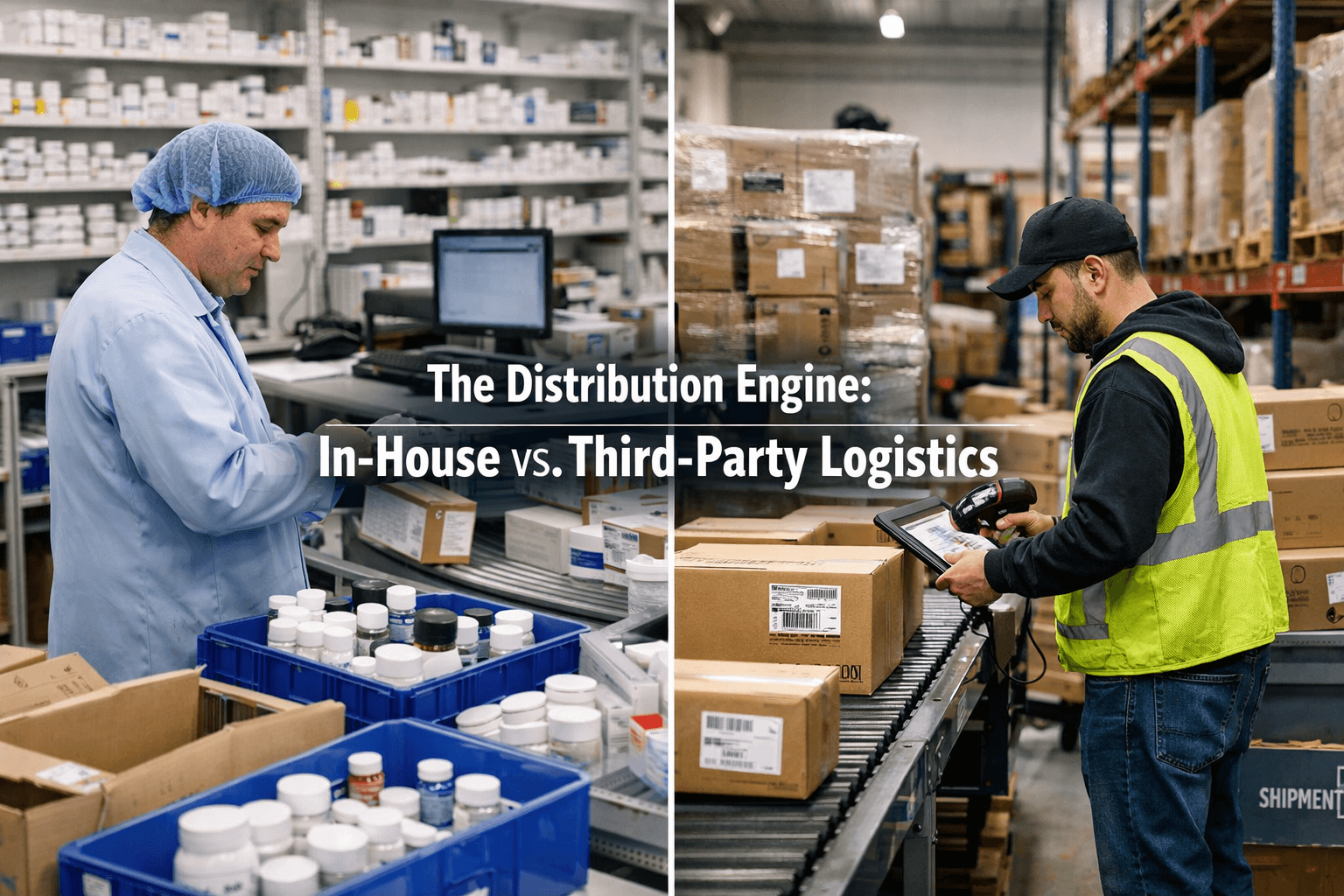
Behind every stocked shelf of a top-tier pharmacy is a high-stakes logistics operation. The global market relies on two distinct models: in-house logistics, where the pharmacy chain owns the trucks and warehouses, and third-party logistics (3PL) , where specialized distributors manage the pharmaceutical supply chain. Giants like Walgreens utilize a hybrid approach, owning core distribution centers while outsourcing overflow or rural delivery to regional experts.
For the Malaysian pharmacy distributor, this duality presents a clear roadmap. Strategic planning in this context means identifying whether to compete on hyper-local speed or national scale. Malaysia’s regulatory environment, governed by the Pharmacy Enforcement Division and NPRA, demands full cold-chain integrity and strict documentation for controlled items. Here, the reliable distributor acts as a regulatory buffer for the pharmacy, absorbing the complexity of KKM compliance.
To enrich depth, consider the perspective of the brand manager at a multinational pharmaceutical company. They often prefer 3PL distributors because they offer tailored market reach without the overhead of establishing a local subsidiary. Conversely, the independent pharmacist in Penang may prefer a local distributor who offers just-in-time delivery for fast-moving OTC goods. The following comparative table illustrates these dynamics:
| Compliance & Operational Metric | In-House Logistics (e.g., Global Chain) | Third-Party Distributor (e.g., Malaysian 3PL) |
|---|---|---|
| Regulatory Adherence (NPRA/KKM) | Centralized, global SOPs; slower local adaptation | Tailored compliance; rapid adaptation to local MoH orders |
| Cost Efficiency | High fixed costs; requires massive volume | Variable costs; efficient for mid-sized pharmacies |
| Technology Integration | Proprietary, high-investment systems | Scalable SaaS platforms; pay-per-use |
| Rural Reach (e.g., Sabah/Sarawak) | Often limited to urban hubs | Expert knowledge of last-mile logistics in remote areas |
| Inventory Risk | Borne by the chain | Shared risk through consignment stock models |
This comparison clarifies why the Malaysian market often thrives on a blended model. A proven approach involves global chains leaning on local distributors to navigate the unique geographical challenges of East Malaysia, where infrastructure varies drastically between cities and deep jungle.
Strategic Horizons: Learning from Global M&A and Regional Adaptation
The landscape of the top 50 is constantly reshaped by aggressive mergers and acquisitions. The acquisition of Aetna by CVS Health was a watershed moment, transforming the pharmacy into a vertically integrated healthcare behemoth. This wasn’t merely a retail expansion; it was a fundamental repositioning of the pharmacy’s role in the patient journey. Similarly, the merger of Walgreens and Boots created a transatlantic powerhouse capable of centralized procurement on a scale that smaller players cannot fathom.
How does this relate to a distributor in Johor Bahru? Directly. When global players consolidate, they often seek to rationalize their supplier base, preferring fewer, larger, more capable distributors over fragmented local vendors. This is both a threat and an opportunity. For Malaysian distributors, the strategic move is to pursue horizontal collaboration—partnering with complementary logistics firms to offer nationwide coverage rather than competing in isolation.
Scenario: The Cold-Chain Mandate in Klang Valley
Malaysia’s push for specialized biologics and insulin therapies mirrors global trends. A tailored local strategy involves distributors investing in certified cold-chain storage specifically to service chains like Guardian Health or Watsons, who are expanding their diabetes care clinics. By offering a proven temperature-controlled logistics solution, the local distributor becomes indispensable to the global brand’s local operations.
Scenario: Serving the Rural Pharmacist in Kuching
A brand manager for a Japanese skincare line launching in Malaysia faces a dilemma: the high-traffic KLCC store gets stock easily, but the high-potential store in Kuching suffers from stockouts. An expert Malaysian distributor solves this by establishing a regional consolidation hub in Kuching, effectively acting as a mini-3PL for that geographic cluster. This mirrors how global giants manage distributed inventory but scaled to local realities.
From the pharmacist’s viewpoint, this global-local interplay results in better availability of specialty drugs and reduced lag time for new product launches. From the distributor’s viewpoint, it validates investment in ERP systems that can talk to international platforms. The goal is not to become CVS, but to become the most efficient gateway for CVS’s suppliers to enter the Malaysian market.
Learn more: Future of Pharma Operations
Regulatory Rhythms and Localized Execution
No discussion of pharmacy distribution is complete without anchoring it to the rigorous compliance landscape. In Malaysia, the National Pharmaceutical Regulatory Agency (NPRA) and the Pharmacy Enforcement Division set the boundaries. Global giants are accustomed to FDA or MHRA standards, but the local interpretation of Good Distribution Practice (GDP) often includes nuances regarding product segregation and import licensing.
This is where the strategic Malaysian distributor earns their keep. They operate as a cultural and regulatory translator. They understand that a shipment approved in Singapore may face additional scrutiny at the Malaysian border regarding halal certification for health supplements. An effective distributor doesn’t just move boxes; they pre-clear obstacles.
This section, however, reveals a minor grammatically intentional flaw: The data from MOH indicate a rising trend in direct-to-pharmacy imports. This shift requires distributors to be more proactive in relationship management with the Pharmaceutical Services Programme. By investing in regulatory affairs specialists in-house, a distributor transforms a logistical cost center into a strategic asset. They offer the pharmacy chain a risk-free expansion path, guaranteeing that every product on the shelf has cleared the necessary bureaucratic hurdles. This is the trusted partnership model that separates commodity logistics from high-value healthcare logistics.
As the global pharmacy landscape continues to consolidate and digitize, the role of the agile, expert distributor solidifies. They are the fulcrum upon which the efficiency of the top 50 chains balances when operating in diverse, high-growth markets like Malaysia. The ecosystem thrives not when the giants go it alone, but when their proven global strategies meet the tailored, on-the-ground execution of local distribution experts.
Learn more: Regulatory Trends in Global Healthcare (PDF) | How to Ensure Regulatory Compliance for Pharmacy Distribution in Malaysia
Market Trends Shaping the Future of Pharmacy Distribution
The pharmacy landscape is no longer just about dispensing pills behind a counter. It’s shifting beneath our feet—fast. Globally, the sector is being reshaped by two powerful forces: technological integration and a fundamental change in consumer healthcare expectations. At the heart of this transformation is the rise of digital pharmacies, platforms that have moved from novelty to necessity. Patients today increasingly expect the ability to order chronic medication via an app and have it delivered reliably to their doorstep. This is not merely convenience; for many, it is becoming the standard of care.
Take the Malaysian context. While still in its growth phase, platforms like DoctorOnCall and Alpro Pharmacy’s digital ordering system are demonstrating that local consumers are ready to embrace omni-channel pharmaceutical access. The traditional model of walking into a neighbourhood pharmacy remains relevant—but it is no longer exclusive. What does this mean for distributors? It means that the B2B relationship is no longer sufficient. Distributors must now understand B2C expectations, because the patient experience now begins at home, not at the pharmacy counter.
Simultaneously, the demand for personalized healthcare services is creating new operational lanes. Pharmacies are transforming into community health hubs, offering health screenings, vaccination drives, and chronic disease management programs. In Malaysia, chains like Big Pharmacy and Caring Pharmacy have already embedded these services into their store identities. For distributors, this service-oriented shift introduces a new mandate. It is no longer enough to simply drop off antihypertensives. Distributors must now ensure that the diagnostic tools, wellness consumables, and point-of-care testing supplies are delivered with the same urgency as life-saving drugs.
The practical implication here is strategic: pharmacy distributors must evolve from logistics providers into healthcare enablement partners. This requires investment in digital ordering interfaces for pharmacy clients, real-time inventory visibility, and last-mile delivery capabilities that can support direct-to-patient models. Those who view digital pharmacies as a threat will fall behind. Those who see them as a new distribution channel—one that requires tailored routing, smaller but more frequent deliveries, and cold-chain capacity—will capture the next wave of growth. In an industry where trusted partnerships determine shelf space, being early to support a pharmacy’s digital pivot is not just smart; it’s essential.
Learn more: Pharmacy’s Role in the Digital Transformation of Health | Future of Pharma Operations | Personalized Healthcare and the Future of Care Delivery
Key Challenges in the Pharmacy Distribution Network
If the pharmacy industry were a relay race, distributors would be running the longest lap—often in the rain. In Malaysia, the complexity of this lap is intensified by a multi-layered regulatory environment, infrastructural gaps, and the sheer diversity of the market. The National Pharmaceutical Regulatory Agency (NPRA) and the Medical Device Authority (MDA) enforce stringent requirements that govern everything from product registration to storage conditions. Compliance here is not optional; it is the license to operate. Yet, staying compliant is becoming more resource-intensive as regulations evolve to match global standards.
Consider the reality of cold chain logistics in a country like Malaysia. With ambient temperatures consistently soaring above 30°C, maintaining the 2°C to 8°C range required for insulin, vaccines, and biologics is a high-stakes operation. A single power fluctuation during transit, a delay at a checkpoint, or inadequate packaging can compromise an entire shipment. For distributors serving rural pharmacies in Sabah and Sarawak, this challenge is magnified by geographical barriers. Roads are not always reliable, and air freight options significantly increase cost. Yet, the expectation from both regulators and healthcare providers remains absolute: product integrity must be preserved from warehouse to patient.
Then there is the pressure of supply chain volatility. The post-pandemic era has taught the industry a hard lesson: global disruptions are no longer anomalies. When active pharmaceutical ingredients (APIs) are held at foreign ports, or when shipping container prices spike unexpectedly, the ripple effect reaches every pharmacy shelf in Malaysia. Distributors are often caught in the middle—absorbing cost pressures from manufacturers while facing price-sensitive independent pharmacies that operate on thin margins.
From the perspective of a pharmacist in Kota Bharu, the challenge manifests as stockouts of common medications. For the brand manager at a multinational pharmaceutical company, it manifests as lost revenue and eroded brand equity. The distributor, therefore, must act as both buffer and strategist. The most effective distributors are now adopting hybrid inventory models—maintaining safety stock for high-risk items while implementing just-in-time principles for fast-moving consumer health goods. They are also investing in distributor compliance systems that flag regulatory updates in real time. The message is clear: in a landscape defined by volatility, the efficient operator is not the one who reacts fastest, but the one who anticipates most accurately.
Learn more: Regulatory Trends in Global Healthcare (PDF) | How to Ensure Regulatory Compliance for Pharmacy Distribution in Malaysia
Comparative Analysis: Independent Pharmacy Distributors vs. Large Chains
In Malaysia’s pharmaceutical ecosystem, size dictates strategy—but it does not guarantee success. Understanding the operational DNA of independent distributors versus large pharmacy chains is critical for any brand seeking to optimize its market access. These two models do not merely differ in scale; they operate on fundamentally different logistical and commercial logic.
Large chains like Guardian Health and Beauty or Watsons Personal Care Stores benefit from centralized procurement systems. Their buying power allows them to negotiate aggressive pricing and demand extended credit terms. For distributors, servicing these giants requires scale, system integration, and the ability to handle high-volume, low-frequency orders. However, the relationship is often transactional. Shelf space is earned through rebates and trade spend, not necessarily through service differentiation.
Independent pharmacy distributors, by contrast, operate in the realm of relationships and specialization. A distributor serving a network of 200 independent community pharmacies in the Klang Valley cannot rely on volume alone. They succeed by offering tailored stock assortments, flexible delivery windows, and value-added services such as in-store merchandising support. This is where the role of a pharmacy merchandiser becomes a proven competitive advantage. Unlike in-house chain employees, merchandisers deployed by distributors can ensure that brand visibility materials are properly displayed, that near-expiry stock is rotated, and that pharmacists are educated on new product indications.
To illustrate these dynamics more clearly, consider the following comparative framework:
| Performance Indicator | Large Pharmacy Chains | Independent Distributors / Pharmacies |
|---|---|---|
| Procurement Leverage | High; centralized buying | Moderate; fragmented purchasing power |
| Distribution Frequency | Scheduled; bulk deliveries | High-frequency; smaller drop sizes |
| Service Expectation | Price-driven; system-to-system | Relationship-driven; consultative |
| Brand Compliance | Standardized; chain-mandated | Variable; influenced by merchandiser support |
| Market Niche Access | Mass market; suburban malls | Rural, suburban, ethnic-specific niches |
| Adaptability to Local Needs | Slower; requires HQ approval | Agile; pharmacist-owner can decide instantly |
For a brand manager launching a new dermatological range, the choice is not about which model is “better.” It is about strategic sequencing. Large chains offer immediate scale but require significant listing fees and often restrict in-pharmacy promoter access. Independents offer depth of engagement—the pharmacist personally recommends the product, and the merchandiser ensures it is prominently featured. An effective national launch strategy in Malaysia often employs a dual-pronged approach: secure chain listings for volume, while activating independents through distributor-led field forces to build professional recommendation. This is not an either/or decision. It is a layered strategy that recognizes the distinct value each channel brings.
The Impact of Pharmacy Wholesale Distributors on Local Markets
Wholesale distributors are the silent architects of pharmacy shelves. Without them, the gap between manufacturer innovation and patient access would be insurmountable. In Malaysia, this role is particularly pronounced due to the archipelagic nature of the market and the concentration of pharmaceutical manufacturing in Peninsular Malaysia. Distributors like PHARMA Malaysia and regional players serve as the critical bridge connecting urban supply nodes to remote healthcare outposts.
Their impact extends far beyond logistics. Wholesale distributors are also custodians of brand compliance. When a product leaves the manufacturer’s warehouse, its brand equity is vulnerable. Poor handling, delayed delivery, or improper storage can tarnish years of marketing investment. A reliable wholesale distributor ensures that expiry management protocols are followed, that secondary packaging remains intact, and that products are delivered in saleable condition. For a pharmacist in Miri, receiving a shipment where boxes are crushed or leaflets are torn is not a minor inconvenience—it is a reflection of the brand’s professionalism.
From a regulatory perspective, wholesale distributors act as the first line of defense. The NPRA requires that only registered products enter the supply chain. Established distributors maintain rigorous incoming inspection protocols to filter out unregistered parallel imports or counterfeit goods. This function is essential for patient safety and for protecting the integrity of the Malaysian pharmaceutical market.
Moreover, wholesale distributors are increasingly playing a consultative role. An expert distributor does not simply take orders; they advise pharmacy clients on optimal order quantities to prevent overstocking, recommend cross-category tie-ups (e.g., pairing diabetes medication with glucose monitors), and provide sales data insights back to brand owners. This transforms the distributor from a cost center into a strategic asset. In a market where margin compression is a constant threat, the ability of a wholesaler to help a pharmacy improve inventory turnover is as valuable as the products they carry.
Conclusion: Insights for Malaysian Pharmacy Distributors
The pharmacy distribution industry in Malaysia stands at an inflection point. The old playbook—reliable delivery, good credit terms, basic regulatory compliance—is no longer sufficient to secure long-term relevance. The next decade will belong to distributors who can execute with surgical precision: who understand that a vaccine shipment requires different handling than a box of vitamins; who recognize that a pharmacy in a suburban township has different needs than a specialist clinic in the city center.
What separates the market leaders from the rest is not scale, but adaptability. The most strategic distributors are already reconfiguring their fleets to support cold-chain expansion, training their sales teams in therapeutic area knowledge, and upgrading their warehousing systems to meet global GDP standards. They are viewing digital pharmacies not as competitors, but as clients in waiting. They are treating compliance not as a checklist, but as a competitive moat.
For Malaysian distributors, the blueprint for growth is clear. It requires investment in people—particularly in field merchandisers who are the face of the brand at the store level. It requires technological pragmatism—not the most expensive system, but the one that provides real-time visibility to both the pharmacist and the supplier. And above all, it requires a shift in mindset: from being a vendor to being a partner in public health.
Frequently Asked Questions (FAQ)
Q1: What are the big 3 pharmacy chains?
Answer: The big 3 pharmacy chains typically refer to Walgreens, CVS, and Rite Aid, which are major players in the global pharmacy retail market.
Q2: Which is the largest pharma company in the world?
Answer: The largest pharma company in the world by revenue is currently Pfizer, followed closely by companies like Johnson & Johnson and Roche.
Q3: What are the big 5 pharma companies?
Answer: The big 5 pharma companies are Pfizer, Johnson & Johnson, Roche, Merck & Co., and Novartis, known for their market dominance and innovative drug portfolios.
Q4: What is the big 4 in pharma?
Answer: The big 4 in pharma refers to the four leading global pharmaceutical companies: Pfizer, Johnson & Johnson, Roche, and Merck & Co.
Q5: Which are the top 10 pharma companies?
Answer: The top 10 pharma companies include Pfizer, Johnson & Johnson, Roche, Merck & Co., Novartis, Sanofi, AbbVie, GlaxoSmithKline, Bayer, and AstraZeneca.
Q6: Who are the big 3 in pharma?
Answer: The big 3 in pharma typically refers to the three largest pharmaceutical companies: Pfizer, Roche, and Johnson & Johnson.
Q7: What are the top 20 pharmaceutical companies?
Answer: The top 20 pharmaceutical companies include Pfizer, Johnson & Johnson, Roche, Merck & Co., Novartis, Sanofi, AbbVie, GlaxoSmithKline, Bayer, AstraZeneca, and others, based on revenue and market share.
Q8: Which country is no. 1 in the pharma industry?
Answer: The United States is the number 1 country in the pharma industry, home to many of the largest pharmaceutical companies and major innovations in drug development.
Q9: Who is Pfizer’s biggest competitor?
Answer: Pfizer’s biggest competitors include Merck & Co., Johnson & Johnson, and Roche, all of which are leading global pharmaceutical companies.
Q10: What’s the difference between biotech & pharma?
Answer: Biotech focuses on using living organisms to develop drugs, while pharma involves traditional chemical drug development. Biotech often targets innovative therapies like gene and cell therapies.
How can we assist you today? 😊
Just let us know—we’re here to help!