

Have you ever wandered down the skincare aisle of a local pharmacy and wondered why some products proudly display a “KKM approved” sticker while others remain silent on the matter? It’s a common point of confusion, not just for consumers, but sometimes even for those within the trade. The reality is that the regulatory framework governing cosmetics in Malaysia is distinct, sitting firmly under the purview of the Ministry of Health (KKM) , with its day-to-day operations expertly handled by the National Pharmaceutical Regulatory Agency (NPRA) . This is where a fundamental distinction must be made: unlike medicines, cosmetics are not registered in Malaysia; they are notified through a system commonly referred to as cosmetic notification Malaysia.
This distinction isn’t just semantic—it is absolutely essential for anyone involved in the supply chain. Pharmaceuticals undergo a rigorous, full-scale registration process involving detailed clinical evaluation and comprehensive dossier review. Cosmetics, however, operate under a notification-based regime that is harmonized with the ASEAN Cosmetic Directive. In practice, this means a company declares its product’s compliance and submits the necessary documentation to the NPRA. KKM does not issue an “approval” for a cosmetic in the same way it does for a therapeutic good; instead, they acknowledge the notification, allowing the product on the market provided it meets all stipulated requirements. For a trusted Pharmacy distribution service in Malaysia, grasping this nuance is not merely beneficial—it is a non-negotiable operational prerequisite. Misclassifying a product, or assuming a cosmetic has undergone the same level of scrutiny as a pharmaceutical, can expose distributors and their retail partners to serious enforcement actions.
Legal Implications for Pharmacies and Distributors
The consequences of non-compliance are far from abstract. Retail pharmacies that list non-compliant cosmetics are putting themselves directly in the line of fire. The risks are tangible and multifaceted:
Product seizure during inspection: NPRA and Pharmacy Enforcement Division officers conduct routine and targeted inspections. Discovering a product without a valid notification number can lead to the immediate confiscation of stock.
Compounded fines: Financial penalties can accumulate quickly, especially if multiple SKUs are found to be non-compliant, creating a significant and unexpected financial burden.
Reputation damage within retail chains: For large pharmacy chains, a compliance breach can strain relationships with head office procurement teams and erode the trust built with franchisors.
Loss of consumer confidence: In an era of informed consumers, news of a product seizure can spread rapidly on social media, directly impacting a pharmacy’s foot traffic and sales.
This environment necessitates that an independent pharmacy distributor adopts a reliable screening process before onboarding any new SKU. The distributor risk exposure is genuine and immediate—especially if the documentation provided by a brand owner is incomplete, or if the notification numbers presented are invalid or do not match the product in the NPRA QUEST system.
Integrating Multiple Perspectives for a Robust Supply Chain

To build a truly compliant supply chain, it’s vital to understand the pressures and responsibilities from every angle:
From the Distributor’s Perspective: They must implement a strategic due diligence protocol before importation. This goes beyond a simple visual check; it involves verifying the notification acknowledgement letter against the physical product, ensuring the Responsible Person (RP) details are accurate, and maintaining meticulous records for every batch.
From the Pharmacist’s Perspective: The pharmacist on duty carries a professional liability. If they advise a customer on the use of a product—especially one for sensitive skin or a specific concern—and that product is later found to be unsafe or mislabelled, their professional standing and the pharmacy’s license could be at risk. They are the final checkpoint before a product reaches the consumer.
From the Brand Owner’s Perspective: The ultimate responsibility for regulatory declarations and maintaining the Product Information File (PIF) rests with them. A lapse in their diligence creates a ripple effect of risk for everyone downstream.
Ultimately, compliance is not merely a checkbox on a form. It is the very foundation of a reliable supply chain operating within Malaysian pharmacies. It’s a shared responsibility that, when executed properly, builds a resilient and trusted market ecosystem.
What “KKM Approved” Really Means for Cosmetics (2027 Clarification)
Does the phrase “KKM approved” actually hold any technical weight when it comes to cosmetics? The short, and technically accurate, answer is no. There is no official “approval” stamp for a cosmetic product in Malaysia. The correct terminology, and the process that matters, is cosmetic notification Malaysia. However, a significant gap exists between regulatory language and public understanding. It is extremely common for consumers, and even some retailers, to use the colloquial terms “kosmetik lulus kkm” or “kelulusan kkm” when referring to products that have successfully completed the notification process.
Understanding this language gap is not just about pedantry; it is a strategic imperative for pharmacy wholesale distributors Malaysia. Relying on surface-level claims like “KKM Approved” printed on packaging is a dangerous shortcut. A proven method for a distributor pharmacy to conduct due diligence is to look beyond the marketing and focus on the verifiable data.
The Notification Number Format and Verification
A compliant cosmetic label will always include a notification number, typically in a format like: NOT24012345K. This isn’t just a random string of characters; it’s a key that unlocks the product’s regulatory status. The crucial step for any efficient distributor is to perform NPRA QUEST verification. This online portal allows anyone to check the validity of a NOT number, ensuring it corresponds to the correct product name, brand owner, and notification status. This single step is a powerful tool in preventing non-compliant goods from entering the supply chain.
The Role of the Responsible Person (RP)
Every notified cosmetic in Malaysia must appoint a Responsible Person Malaysia entity. This is a critical requirement that often gets overlooked during a quick visual inspection. The Responsible Person (RP) is the legally accountable party for that product in the country. Their obligations are substantial and ongoing:
Maintains the comprehensive Product Information File (PIF) , which contains data on the product’s safety, manufacturing, and efficacy.
Ensures all labelling compliance aspects are met, from ingredient listing to claim substantiation.
Acts as the primary point of contact to respond to any regulatory inquiries or adverse event reports.
If the RP’s name or address is missing on the packaging, mismatched with the details in the NPRA database, or unclearly printed, this is a major red flag. It signals a fundamental failure in the compliance setup.
Importer and Local Entity Obligations
For imported cosmetics, the regulations are crystal clear: there must be a legally registered Malaysian entity that is ultimately responsible for the product’s regulatory compliance. A distributor cannot and should not assume that the overseas brand owner has handled this correctly. Verification must be independent, thorough, and accurate. A strategic partner will always verify that the local entity listed as the RP or importer is active and in good standing with the Companies Commission of Malaysia (SSM) .
Multiple Perspectives on a Shared Challenge
The confusion around “KKM approval” affects everyone, but in different ways:
Distributor Pharmacy: Must verify the notification authenticity through the official NPRA database, ignoring any marketing jargon on the box.
Brand Manager: Should ensure that the final printed artwork sent for production exactly matches the details declared in the cosmetic notification submission, including the precise wording of claims and the RP address.
Regulatory Officer: During an inspection, they will cross-check the packaging against the declared submissions in the NPRA system. Any discrepancy, no matter how small, is grounds for further investigation and potential action.
By truly understanding what kkm approval practically implies for cosmetics, all stakeholders can work from a common, accurate framework, preventing costly compliance confusion across the entire supply chain.
Learn more: KKM Product Verification: What You Need to Know | How To Check KKM Passed Products Offline 2026
Packaging Checkpoint #1: Notification Number & Responsible Person Details
When a new product arrives at a warehouse for intake, what is the very first thing a diligent quality assurance officer should look at? Before considering the fragrance, the texture, or the marketing appeal, their focus must snap to the regulatory identifiers. The NOT number is the product’s passport into the Malaysian market, and it must appear clearly on the outer packaging or the immediate container. It is not enough for it to be hidden on a leaflet inside; it must be legible, complete, and consistent with the product’s declared identity.
A Step-by-Step Mock Review Scenario
Let’s walk through a typical warehouse intake review for a pharmacy distributor to illustrate an efficient and proven approach:
Receive product carton: The process begins the moment a pallet arrives. A sample is pulled from the delivery for a compliance check before the entire shipment is accepted into inventory.
Inspect physical packaging: The officer visually scans the primary display panel and the information panel for the notification number. They check for any signs of tampering, such as stickers covering original text.
Locate NOT number: They note the full number, e.g., NOT27012345K.
Perform NPRA QUEST verification: The officer logs into the NPRA QUEST portal and enters the NOT number. The system should return the product name, brand owner, notification holder, and status.
Cross-check RP details with SSM registration: The Responsible Person’s name and address, as printed on the packaging, are verified against the details in the NPRA database and then cross-referenced with the SSM database to ensure the company is active and the address is current.
Record findings in internal system: The results of this verification, along with a timestamp and the officer’s name, are logged into the distributor’s internal inventory management system. This creates a clear audit trail.
This strategic and systematic approach prevents future regulatory disruptions and builds a culture of compliance.
Red Flags That Demand Immediate Attention
An experienced warehouse team knows the warning signs. These red flags should trigger an immediate hold on the product and a review with the compliance manager:
A blurred, incomplete, or poorly printed NOT code that is difficult to read.
The NOT number is valid in the NPRA database, but the product name listed online does not match the name on the physical box. This is a serious discrepancy.
The RP address printed on the packaging is inconsistent with the official address listed in the SSM company profile.
Stickers are being used to cover original text on the packaging, which often indicates an attempt to rectify an earlier printing error or to bypass compliance steps.
Why This Matters for the Independent Distributor
For an independent pharmacy distributor network, implementing a reliable internal Standard Operating Procedure (SOP) is the backbone of risk management. This SOP must include:
Mandatory verification before SKU activation: No product is entered into the system or made available for sale until this verification is complete and signed off.
Digital record storage: All verification records, including screenshots from NPRA QUEST, should be stored digitally for easy retrieval during audits or inspections.
Compliance approval sign-off: A designated compliance officer or manager should provide the final electronic sign-off, creating a clear line of accountability.
A missing notification number is not a minor oversight; it is a direct invitation for enforcement action. More importantly, it is a strong signal of a weak compliance culture from the brand owner, suggesting that other corners may have been cut in the product’s formulation, manufacturing, or documentation. Partnering with such a brand introduces unacceptable risk.
Packaging Checkpoint #2: Ingredient List, Claims & Labelling Compliance
So, a product has a valid NOT number and the Responsible Person details check out. Is it now safe to assume the product is fully compliant and ready for the shelves? Not entirely. A valid notification number is a crucial first step, but it is not a guarantee of safety or full compliance. The cosmetic labelling Malaysia requirements are detailed and exist for a reason: to protect the consumer. This second checkpoint involves a deeper dive into the product’s identity—its ingredients, its promises, and its language.
INCI Naming Standards and Ingredient Disclosure
All ingredients must be listed on the packaging using the International Nomenclature of Cosmetic Ingredients (INCI) . This is the standardized system for naming cosmetic ingredients, allowing for universal identification regardless of language. Vague or marketing-driven descriptions such as “herbal extract blend,” “proprietary moisturizing complex,” or “active natural ingredients” are insufficient and non-compliant. Consumers have a right to know exactly what is in the product, especially those with allergies or sensitivities. An effective compliance check involves scanning the ingredient list for any non-INCI terminology.
Prohibited and Restricted Ingredients
Under the ASEAN Cosmetic Directive, certain substances are strictly prohibited, while others are restricted to specific concentration levels and usage conditions. This is a critical area of focus for distributor pharmacy teams, particularly for products in higher-risk categories. For instance, skin-lightening products or anti-acne treatments often contain active ingredients that fall under restricted lists. A failure to screen these ingredient lists carefully can lead to a product being on the market that contains a banned substance or a restricted substance at an unsafe level, posing a direct risk to consumer health and inviting severe regulatory penalties, including a product recall.
The Danger of Misleading Claims
The claims made on a cosmetic product are a powerful marketing tool, but they must be truthful, substantiated, and not misleading. Claims that venture into therapeutic territory are a particular area of concern. Phrases such as:
“Medical-grade”
“Clinically proven cure” for a skin disease
“Dermatologist approved” without verifiable evidence from a specific, named dermatologist or institution
Any implication that the product can treat, cure, or prevent a disease
These are red flags that can mislead consumers and attract the scrutiny of regulators. A proven claim should be specific, measurable, and supported by the data held within the Product Information File (PIF) .
The Requirement for Bahasa Malaysia Labelling
Malaysia’s national language policy extends to consumer goods. Products sold locally must include Bahasa Malaysia labelling information for certain key elements, such as product name, function, and precautionary statements. While a bilingual approach (English and Bahasa Malaysia) is common and often best practice, a complete absence of Bahasa Malaysia on the packaging is a clear act of non-compliance.
Multiple Perspectives on Labelling Compliance
Pharmacist: Reviews product claims for ethical appropriateness, ensuring that the advice they might give a customer does not inadvertently reinforce a misleading or unsubstantiated therapeutic claim.
Merchandising Team: Evaluates the risk of shelf placement, considering how the product’s packaging and claims will be perceived by customers and whether it aligns with the pharmacy’s professional image.
Brand Manager: Bears the ultimate responsibility for aligning the final printed artwork with the notification submission and ensuring all claims are substantiated and compliant.
In the end, labelling compliance is not just about avoiding fines; it is essential for maintaining expert-level retail standards and building lasting consumer trust. A compliant label is a silent promise of safety, quality, and honesty.
Learn more: ASEAN Cosmetic Directive
Documentation Review: Supporting Files Every Pharmacy Distributor Malaysia Should Request
Would you ever consider onboarding a significant new product into your distribution network without first reviewing its foundational documents? In the world of pharmaceutical and cosmetic distribution, the product on the shelf is merely the visible tip of a much larger compliance iceberg. Packaging is the visible face of compliance, but documentation is the backend compliance that provides the real proof of a product’s integrity and regulatory standing. A strategic Pharmacy distribution service in Malaysia understands that its duty of care extends far beyond a simple visual scan; it involves a meticulous review of the product’s paper trail.
Core Documents to Request from Every Supplier
Before any agreement is finalized and any stock is ordered, a reliable distributor should have a standard checklist of documents to request from the brand owner or supplier. This is non-negotiable. The core set includes:
Notification acknowledgement letter: This is the official document from NPRA confirming the product’s notification status. It’s the primary evidence.
Product Information File (PIF): This is the product’s comprehensive technical dossier. It contains detailed information on its formulation, safety assessment, manufacturing method, and proof of claims. Reviewing the PIF is the gold standard of due diligence.
Certificate of Analysis (COA): Ideally for each batch, the COA provides laboratory-confirmed data that the product meets its specified quality standards and is free from contaminants.
Import permit (if applicable): For products manufactured overseas, proof that the importation was conducted legally and declared to the proper authorities is essential.
Distribution agreement: A clear, legally binding contract that outlines the responsibilities of each party, including who bears liability in the event of a compliance breach.
This is the arena where a truly strategic Pharmacy distribution service in Malaysia differentiates itself from a mere logistics provider. They are not just moving boxes; they are curating a compliant and trusted portfolio for their pharmacy clients.
A Comparative Framework for Compliance Verification
To bring clarity to this process, a comparative table can be an invaluable tool for internal training and operational consistency. It helps teams quickly distinguish between the bare minimum and best practice.
| Verification Area | Minimum Requirement | Best Practice for Distributors | Risk if Ignored |
|---|---|---|---|
| NOT Number | Printed on packaging | Verified in NPRA QUEST database and cross-referenced with product name. | Regulatory action, including product seizure and fines. |
| RP Details | Name and address printed clearly on label. | Cross-checked with SSM company profile for active status and correct address. | Legal liability for selling products with no accountable local party. |
| Ingredient List | Listed in INCI format on packaging. | Screened against ASEAN Cosmetic Directive lists for prohibited/restricted substances. | Consumer safety incident and mandatory product recall. |
| Product Information File (PIF) | Stated to be available by the brand owner. | Physically reviewed, or a summary of its key safety data is obtained and filed before listing. | Compliance breach discovered during an audit, with no safety data to present. |
Adopting such a framework transforms the onboarding process from a subjective exercise into an objective, proven system. It empowers the compliance team to make clear, data-driven decisions.
The Strategic Value of a Reliable Documentation Process
A reliable documentation process is the ultimate safeguard. It protects both the retailer, who relies on the distributor’s expertise, and the distributor themselves, who must be able to demonstrate their own due diligence. When an audit occurs—and for a serious operator, it’s a matter of when, not if—having a complete and organized digital file for every single SKU is the only way to confidently and quickly respond to regulatory queries. This level of preparedness builds an unshakeable foundation of trust with pharmacy partners and positions the distributor as an expert and trusted gatekeeper in the Malaysian healthcare supply chain. It’s an investment in reputation and long-term business resilience.
Learn more: Cara Semak Produk Supplement Lulus KKM
Operational Implementation: Structuring a Pharmacy Compliance SOP
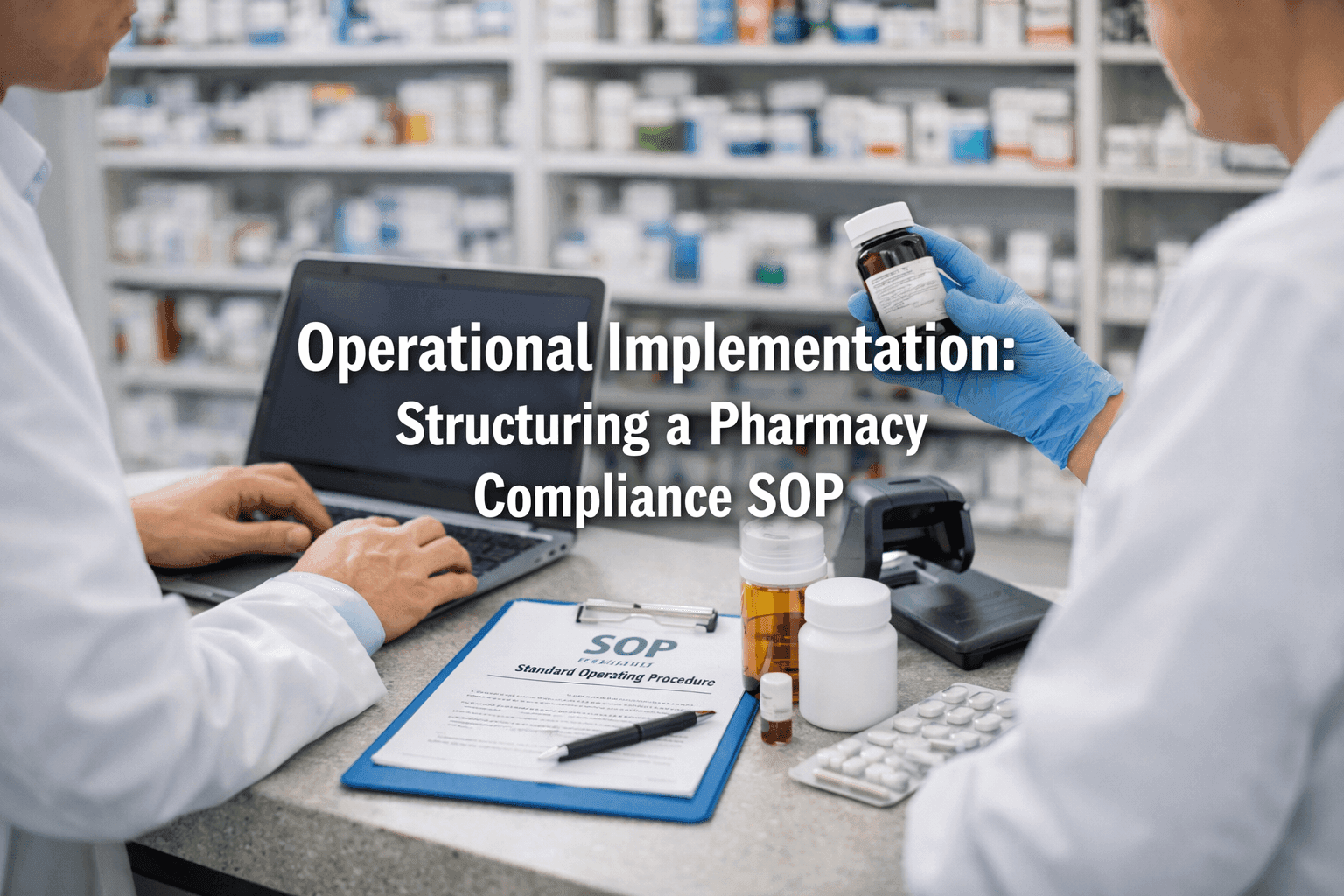
How do you transform the theory of regulatory verification into daily operational practice across a busy distribution network? This is the question that separates organisations with true compliance cultures from those merely paying lip service. The answer lies in structure—specifically, in a well-designed Standard Operating Procedure (SOP) that embeds compliance checks into the natural workflow of the business. Without this, even the most well-intentioned teams can miss critical red flags when faced with the pressure of moving high volumes of stock.
A proven approach to building a compliance SOP begins with centralising the process. It cannot be left to the memory or discretion of individual staff members, no matter how experienced they are. The framework must be systematic, leaving no room for ambiguity. The key elements of an effective SOP should include:
Centralised compliance checklist: A master document that lists every single verification point for a new SKU, from NOT number validation to PIF availability, ensuring nothing is overlooked.
SKU onboarding approval workflow: A formal, multi-step process that requires specific approvals at each stage before a product can be officially listed and ordered.
Segregation of duties (sales vs regulatory team): The team responsible for meeting sales targets should not be the same team responsible for compliance sign-off. This separation creates a crucial system of checks and balances.
Audit documentation storage: A dedicated, organised digital repository for all compliance records, making them instantly accessible during internal reviews or regulatory inspections.
Warehouse Intake Flow Example in Practice
Let’s visualise how this SOP comes to life on the warehouse floor of a major pharmacy distributor in Malaysia. The process is designed to be both efficient and rigorous:
Goods received: A shipment arrives. It is immediately flagged for intake inspection and held in a quarantine area.
Compliance desk review: A designated compliance officer pulls a sample from each batch and conducts a thorough review against the centralised checklist, examining labelling, notification numbers, and physical condition.
NPRA database cross-check: Every single NOT number is manually verified on the NPRA QUEST portal. Screenshots are taken and saved as digital proof.
Regulatory sign-off: The compliance officer logs their findings. If all checks pass, they provide a formal electronic sign-off in the system. If any issue arises, the batch remains on hold.
ERP activation: Only after receiving the digital compliance sign-off is the product activated in the Enterprise Resource Planning (ERP) system, making it available for sale and dispatch to pharmacies.
This structured intake flow ensures consistent standards are applied nationwide, whether the warehouse is in Penang, Johor Bahru, or Kuching. It removes guesswork and replaces it with a reliable system.
Stakeholder Roles in the Compliance Chain
For the SOP to function seamlessly, every team must understand their specific role within the larger framework:
Warehouse Team: Conducts the initial physical inspection, checking for damage, correct quantities, and obvious labelling issues like missing NOT numbers before the product even reaches the compliance desk.
Procurement Manager: Their role is to ensure that all requested compliance documents—notification letters, PIF summaries, COAs—are received from the brand owner before a purchase order is ever issued. This proactive step prevents wasted effort on non-compliant sourcing.
Merchandising Team: Responsible for ensuring that any in-store promotional materials, shelf talkers, or online listings do not make claims that the product’s packaging itself does not make, avoiding the creation of non-compliant marketing.
Adopting proven SOP frameworks is not just about organisation; it is a direct and powerful method to reduce regulatory risk significantly. It builds a wall of due diligence around the entire distribution operation.
Learn more: GUIDELINE ON GOOD DISTRIBUTION PRACTICE
Risk Management & Enforcement: When Labels Are Non-Compliant
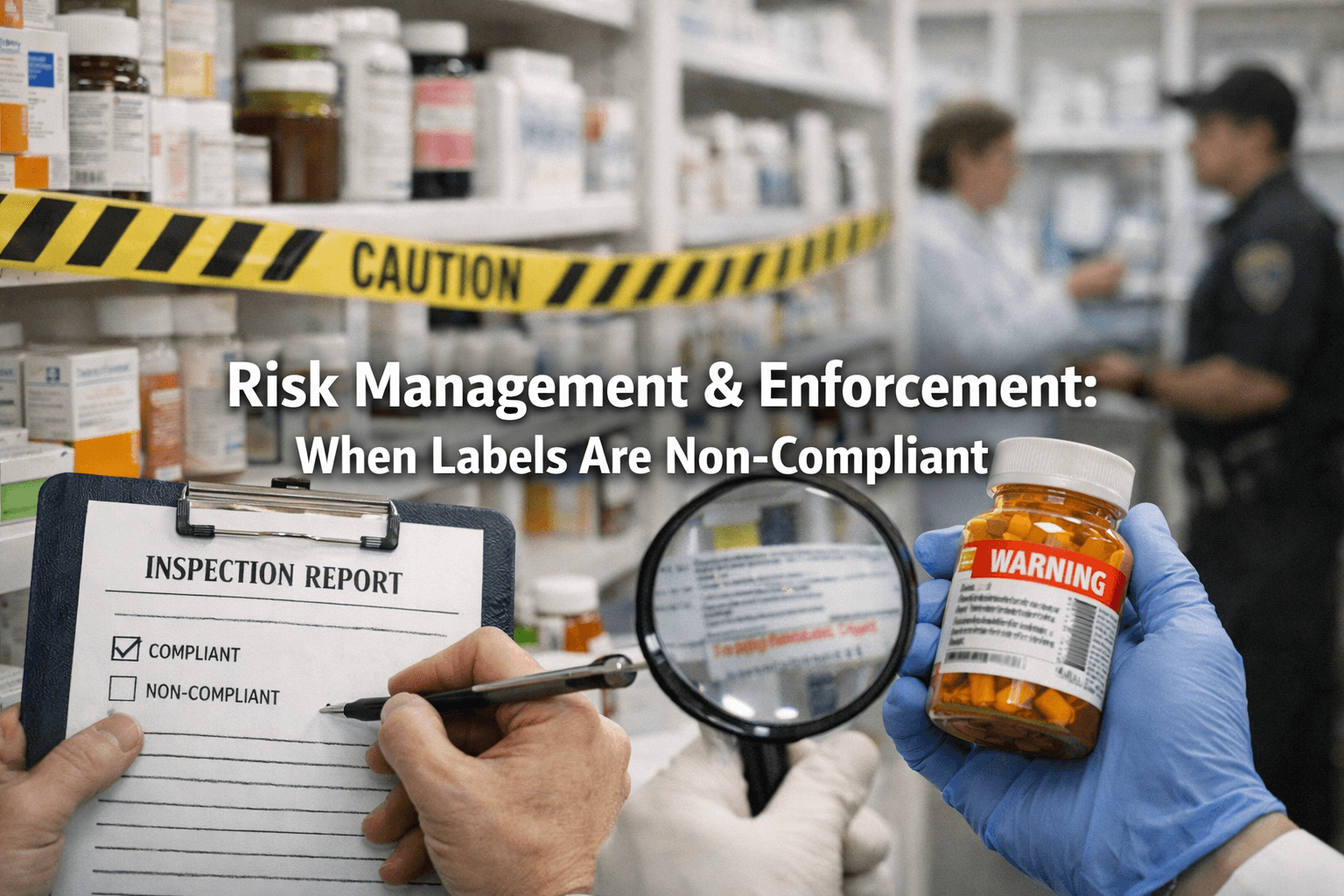
What is the real-world consequence when a cosmetic label fails a compliance review and that product has already made its way onto pharmacy shelves? The scenario shifts from internal process to external enforcement, and the stakes rise dramatically. KKM enforcement actions are not theoretical; they are carried out regularly and can have a devastating impact on a business. The potential actions include:
Product seizure: Officers from the Pharmacy Enforcement Division can arrive at a warehouse or pharmacy and remove non-compliant stock immediately, creating supply chain gaps and financial loss.
Public recall notice: A formal recall is a public declaration that a product is unsafe or illegal, causing immediate and often irreversible consumer distrust.
Fines: Financial penalties can be levied against the distributor, the retailer, or both, cutting directly into profitability.
Brand blacklisting: Repeat or serious offenders can find their products effectively barred from major pharmacy chains, who will refuse to list any SKU from that brand owner.
For the headquarters of a chain pharmacy, even a single compliance lapse at one outlet is never an isolated incident. It sends shockwaves through the organisation, affecting nationwide brand trust. A recall in one store becomes national news within the industry, damaging carefully cultivated relationships with suppliers and franchisors who question the chain’s overall governance.
The Nature of Reputational Damage
It is crucial to understand that retail pharmacy compliance audit failures are not isolated events confined to a single store or a single product. They ripple outward, affecting the entire ecosystem. When a major pharmacy chain is publicly cited for selling non-compliant goods, the reputational damage extends to their distributor partners, who may be seen as having failed in their gatekeeper role. The trust built over years can be eroded in a single news cycle.
Strategic Risk Mitigation for Distributors and Pharmacies
A trusted distributor does not view compliance as a burdensome administrative task; they treat it as critical infrastructure that protects their business and their clients’ reputations. Implementing a robust risk mitigation strategy involves several ongoing activities:
Periodic compliance audit: Conducting internal audits of your own inventory, not just at intake but randomly throughout the year, to catch any issues that might have been missed.
Random shelf sampling: Visiting partner pharmacies unannounced to pull random samples from the shelves and re-verify their compliance status, ensuring the integrity of the stock in the field.
Staff training refreshers: Regularly updating warehouse, procurement, and sales teams on the latest regulatory requirements and common pitfalls.
Internal regulatory risk management pharmacy dashboard: Creating a centralised digital dashboard that tracks key compliance metrics—such as number of SKUs verified, pending document requests, and audit results—giving management real-time visibility into their risk posture.
This proactive, multi-layered approach is the hallmark of a reliable supply chain partner.
Learn more: NIQ Report Reveals 2025 Global Health & Wellness Trends
The Role of Pharmacy Distribution Service in Malaysia in Protecting Retail Integrity
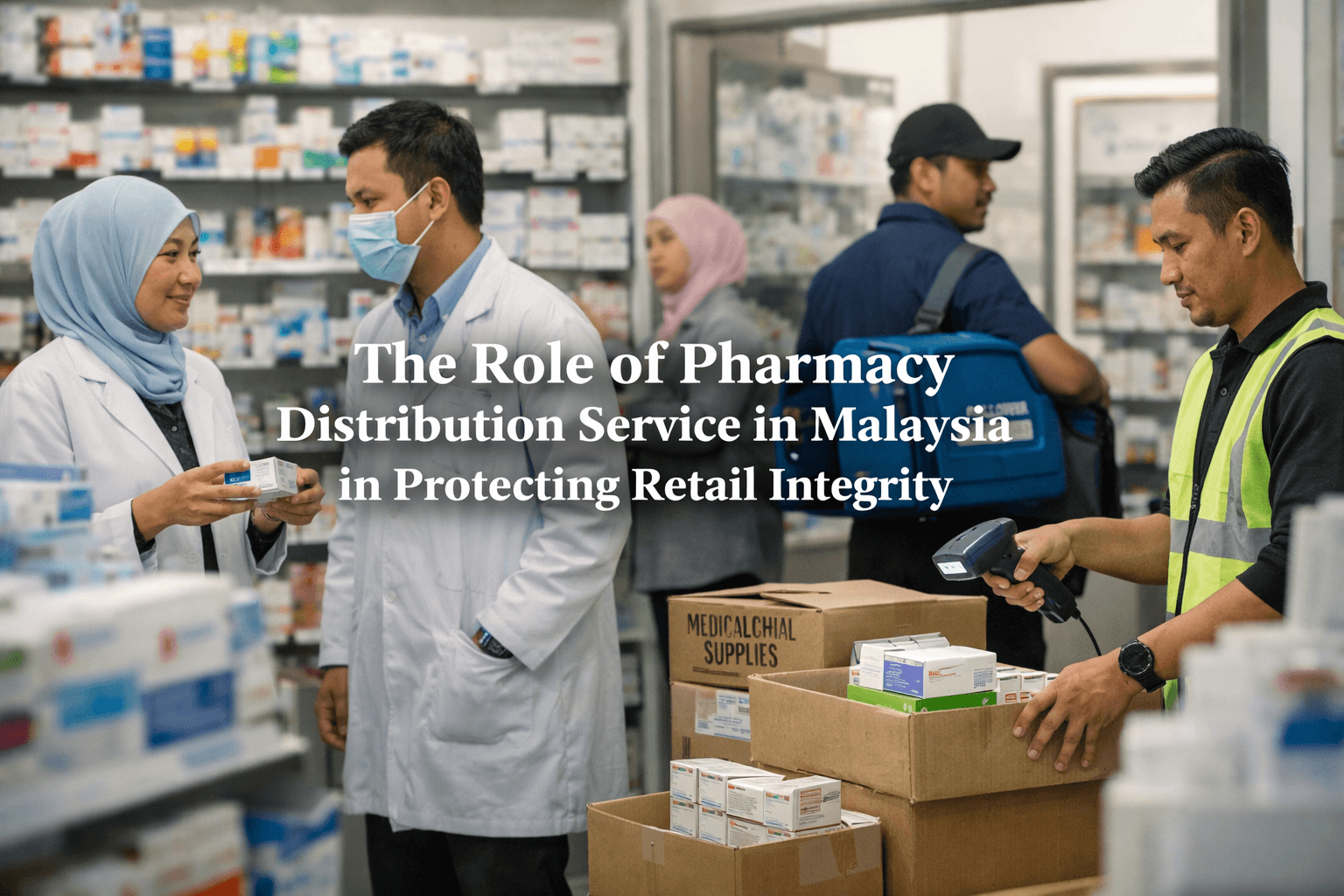
In the complex web of the pharmaceutical supply chain, who ultimately holds the responsibility for protecting the integrity of the pharmacy shelf? Is it the brand owner, the regulator, or the retailer? While all share a piece of the duty, the distributor pharmacy partners occupy a uniquely powerful position as the final gatekeepers. They are the last point of control before a product is dispersed to hundreds or thousands of retail outlets. An expert distributor ensures that only compliant kkm produk enter these retail channels, effectively filtering the market for their pharmacy clients.
This role becomes even clearer when comparing the capabilities of a business managing its own imports versus one leveraging a specialised distributor-managed compliance system.
Comparative Table: In-House Import vs Distributor-Managed Compliance
| Criteria | In-House Import (Brand/Retailer) | Distributor-Managed Compliance |
|---|---|---|
| Regulatory Expertise | Often limited; relies on one or two internal staff. | High; supported by a dedicated expert team with diverse experience. |
| SOP Structure | Can be variable and informal, changing with personnel. | Formal, documented, and consistently applied. |
| Audit Preparedness | Often reactive; scrambling to find documents when an audit is announced. | Proactive; records are maintained and ready for immediate inspection at all times. |
| Risk Exposure | Higher, as the full burden of due diligence falls on a single entity. | Lower, as risk is managed through a structured, multi-layered system. |
As the table illustrates, reliable distributor oversight provides a layer of protection that is difficult for individual companies to replicate internally. This enhances brand sustainability as products move through Malaysian chains, ensuring they remain on shelves and out of regulatory trouble.
Building a Culture of Compliance Through Education
Beyond their filtering function, top-tier distributors also act as educators. They initiate education initiatives for pharmacists and store managers, training them on what to look for, what questions to ask, and how to spot potential non-compliance. This elevates the entire ecosystem, creating a network of informed professionals who can collectively safeguard consumer safety and industry reputation.
2027 Compliance Updates & Future Outlook
As the industry looks ahead, what significant shifts in the compliance landscape should pharmaceutical companies, distributors, and brand owners prepare for? The pace of change is accelerating, driven largely by technology. The days of manual paper-based checks are numbered. Digital transformation is fundamentally reshaping how regulatory verification is conducted, moving from reactive checks to proactive, data-driven assurance.
Emerging Trends in Regulatory Technology
Several key trends are beginning to emerge that will define the future of compliance for pharmacy wholesale distributors Malaysia:
QR-based traceability linked to NPRA database: Imagine a future where every compliant product carries a unique QR code. A simple scan by a pharmacist, distributor, or even a consumer instantly pulls up the product’s notification status directly from the NPRA database, eliminating any guesswork.
POS-integrated compliance alerts: Point-of-sale systems in pharmacies could be integrated with a central compliance database. If a non-compliant or recalled product is scanned at the cash register, the system could automatically flag the transaction and prevent the sale.
ESG transparency requirements: As environmental, social, and governance (ESG) criteria become more important, distributors may be required to provide proof of ethical sourcing, sustainable packaging, and responsible manufacturing as part of the compliance package.
Centralised distributor compliance dashboards: Distributors will likely invest in sophisticated digital dashboards that aggregate compliance data from all brand partners, providing a real-time, bird’s-eye view of their entire portfolio’s regulatory health.
These are not distant possibilities; they are emerging trends that forward-looking companies are already beginning to explore. The message is clear: future compliance will be data-driven, not paper-based. It will be continuous, not periodic. Investing in efficient digital verification systems today is not just about keeping up; it’s about building a competitive advantage for tomorrow.
Learn more: Clean Pharmaceutical Supply Chain with Full Traceability
Conclusion: Strengthening Compliance Across Malaysia’s Pharmacy Ecosystem
Identifying a truly compliant cosmetic label in today’s market requires far more than a quick glance at a code on a box. It demands a disciplined, multi-layered approach. It requires a structured SOP that governs every intake, a rigorous documentation review that goes beneath the surface, operational discipline at the warehouse level, and cross-functional coordination between procurement, compliance, sales, and merchandising teams. These are the building blocks of a resilient supply chain.
For pharmaceutical companies, skincare brand owners, and distributor pharmacy operators operating within Malaysia, the message is consistent and clear: strong verification systems are not a cost of doing business; they are an investment in long-term retail credibility and brand protection. In an environment where consumer trust is the ultimate currency, a reputation for reliability is the most valuable asset a company can possess.
Frequently Asked Questions (FAQ)
Q1: What is KKM, and why is it important for healthcare products in Malaysia?
Answer:
KKM stands for Kementerian Kesihatan Malaysia (Ministry of Health Malaysia). It ensures all healthcare products—including supplements, cosmetics, and medical devices—are safe, effective, and meet national quality standards before they reach consumers.
Q2: Which agencies under KKM regulate product safety and approval?
Answer:
Three main agencies operate under KKM:
NPRA (National Pharmaceutical Regulatory Agency) – regulates medicines, supplements, and cosmetics.
MDA (Medical Device Authority) – oversees medical equipment and devices.
BPFK/NPRA Cosmetic Division – manages cosmetic product notifications and safety assessments.
Q3: What types of products require KKM registration or approval?
Answer:
Products that must be verified by KKM include pharmaceuticals, dietary supplements, traditional herbal remedies, cosmetics, and medical devices. Each category has specific certification requirements such as MAL, NOT, or MDA numbers.
Q4: How can businesses check if a product is registered with KKM?
Answer:
Verification can be done through official KKM platforms:
NPRA QUEST3+ – for drugs, supplements, and traditional medicines.
MDA Search Portal – for medical devices.
NPRA Cosmetic Notification Portal – for cosmetics with NOT numbers.
Q5: What do MAL, NOT, and MDA numbers mean on product labels?
Answer:
MAL Number: Shows registration for medicines, supplements, or herbal products.
NOT Number: Identifies approved cosmetic products.
MDA Number: Confirms a licensed and approved medical device.
Q6: What are the penalties for selling unregistered or fake KKM products?
Answer:
Businesses found selling unregistered products can face heavy fines, product seizures, license suspension, or even permanent closure. Such violations also damage consumer trust and brand reputation.
Q7: How do pharmacy distributors apply KKM checks in their daily work?
Answer:
Distributors verify product codes (MAL, NOT, MDA) using KKM portals before listing or restocking. Many also store screenshots or digital records for audit purposes and integrate verification into daily Standard Operating Procedures (SOPs).
Q8: Why is KKM compliance so important for pharmacies and distributors?
Answer:
Compliance ensures legal operation, customer safety, and brand credibility. It prevents penalties, builds retailer trust, and enhances market access for certified products.
Q9: What steps can companies take to strengthen KKM compliance?
Answer:
Firms should perform monthly audits, train staff to recognize certification labels, use digital tools for record-keeping, and keep updated with NPRA and MDA guidelines to avoid compliance errors.
Q10: How can PriooCare assist with KKM compliance and distribution?
Answer:
PriooCare helps pharmacy distributors manage regulatory audits, documentation, and logistics. Their compliance expertise simplifies KKM verification, minimizes business risk, and ensures all distributed products meet Malaysia’s health regulations.
How can we assist you today? 😊
Just let us know—we’re here to help!