

The healthcare sector in Malaysia is not merely an economic contributor; it is the structural framework that upholds public health and national resilience. As the industry expands—fueled by aging demographics, rising chronic disease prevalence, and an increasingly health-conscious population—the machinery behind medicine delivery has shifted from background utility to strategic necessity. Pharmacy distribution services have emerged as the circulatory system of this ecosystem. Without them, the most advanced hospitals, the most skilled clinicians, and the most innovative pharmaceutical manufacturers remain siloed, unable to deliver value to the patients who need it most. These services do not just move boxes; they ensure therapeutic continuity, maintain cold chain integrity, and navigate a dense web of regulatory protocols so that a pharmacist in Kota Kinabalu can dispense the exact same quality of medication as a specialist center in Kuala Lumpur.The pharmaceutical supply chain in Malaysia is a high-stakes environment. A single lapse in temperature control can render biologic drugs useless. A documentation error can halt an entire shipment at customs, leading to stock-outs at hospital pharmacies. This is where proven distributors differentiate themselves. They are not passive transporters but active compliance guardians. Their role extends into regulatory navigation, working hand-in-glove with bodies such as the NPRA and KKM to ensure every product—whether an innovator biologic or a generic alternative—meets GMP standards. This infrastructure is especially vital for Malaysia’s dual-tier healthcare system, where the private sector drives speed and choice, and the public sector shoulders the burden of universal coverage. Efficient distribution bridges the gap between these tiers, ensuring that medicine availability does not become a fault line of inequality.
The Regulatory Compass: Navigating NPRA, KKM, and GMP in Daily Operations
Malaysia’s healthcare landscape is characterized by regulatory rigor that would challenge even seasoned multinational operators. The Ministry of Health (KKM) sets the policy direction, while the National Pharmaceutical Regulatory Agency (NPRA) acts as the scientific gatekeeper. For any pharmacy distributor, compliance is not a one-time audit exercise; it is a daily operational rhythm. Products must be registered, facilities must be licensed, and Good Distribution Practice (GDP) —an extension of GMP principles—must be woven into every logistical step. This is not merely bureaucratic overhead; it is the mechanism that separates reliable supply chains from dangerous counterfeits and degraded therapeutics.
Consider the reality of independent pharmacy distributors operating in Malaysia. They must simultaneously satisfy principal manufacturers (who demand strict handling protocols) and retail clients (who demand just-in-time delivery). They manage controlled medicines under strict Poison Act enforcement, ensuring that opioids and psychotropics are not lost or diverted. The strategic implication here is clear: regulatory expertise has become a competitive moat. Companies that treat compliance as a checkbox exercise inevitably face NPRA suspension notices or customs seizures. In contrast, expert distributors embed regulatory affairs officers within their operations teams, ensuring that every inbound shipment is pre-cleared for documentation before it lands at Port Klang.
From the perspective of a hospital pharmacist: “I don’t care which distributor the product came from as long as it arrives with full traceability, intact cold chain indicators, and a valid expiry date. If the distributor fails compliance at their end, I’m the one explaining to the patient’s family why surgery is delayed.”
From the perspective of a brand manager at a multinational pharmaceutical company: “We select Malaysian partners based on their NPRA liaison capability. If they can’t navigate the registration backlog or manage variation submissions efficiently, our product launch is dead on arrival.”
The regulatory environment is not static. The NPRA’s mandate continues to expand, particularly around biologics, biosimilars, and vaccine distribution. Post-pandemic, the expectations for pharmacy wholesale distributors have intensified; authorities now scrutinize audit trails and temperature excursion reports with forensic detail. This makes the role of pharmaceutical distributors not just operational but essential to national health security.
Learn more: Licensing for Pharmaceutical Manufacturers, Importers and Wholesalers in Malaysia | Key Regulations Governing Pharmacy Distribution in Malaysia | WHO Initiatives on Health Systems and Policy
Distributor Pharmacies: The Operational Backbone of Medicine Availability
When a patient walks into a community pharmacy in Malaysia seeking medication for hypertension or diabetes, they assume the product will be there. That assumption rests on thousands of daily decisions made by distributor pharmacies. These entities operate in the gap between manufacturer shipment schedules and retail point-of-sale data. They absorb demand volatility, finance inventory holding costs, and de-risk the supply chain for smaller retail players who lack warehousing capacity. In Malaysia, independent pharmacy distributors are particularly vital for the rural and semi-urban markets, where major wholesalers may not maintain dense coverage.
The operational challenges are multi-dimensional. Inventory management requires forecasting across hundreds of SKUs with erratic consumption patterns. Cash flow pressure is acute because hospital tenders often operate on 90-to-120-day payment terms, while distributors must pay manufacturers upfront. Furthermore, the shift toward specialty pharmaceuticals—such as oncology infusion drugs and immunomodulators—demands cold chain logistics capabilities that are expensive to maintain. A single cold chain failure can write off hundreds of thousands of ringgit in inventory.
A Malaysia-specific example illustrates this tension. A distributor serving government health clinics (klinik kesihatan) in Sabah must manage deliveries to facilities accessible only by logging roads or small aircraft. The cost per drop is exponentially higher than delivering to a pharmacy in the Klang Valley, yet the selling price is fixed by government tender. Strategic distributors cross-subsidize these challenging routes with higher-margin business from private hospital groups, maintaining their proven ability to serve the nation’s B40 communities.
The comparative role of in-house logistics versus outsourced merchandisers is also worth examining. Many pharmaceutical principals debate whether to deploy their own field force or rely on distributor sales teams to drive retail off-take.
| Compliance & Commercial Activity | In-House Brand Team | Distributor Merchandiser |
|---|---|---|
| Product knowledge depth | High (focused on 1–2 brands) | Moderate (covers portfolio) |
| Shelf-level execution control | Direct | Indirect (via principal guidelines) |
| Cost per call | High | Shared across principals |
| Regulatory compliance risk | Managed centrally | Requires joint SOPs |
| Relationship with pharmacy owners | Brand-specific | Multi-brand, multi-category |
| Data capture at retail | Limited to own products | Broader category visibility |
This table reveals a critical insight: neither model is universally superior. The most effective pharmacy distribution strategies often blend both approaches—using in-house teams for strategic account management and new product launches, while relying on distributor merchandisers for efficient cycle filling and territory coverage expansion.
Learn more: The Future of Pharma Operations
Company Profile #1: Anchor of Trust in a Fragmented Market
Company Profile #2: Digital-First Agility Reshaping Pharmacy Logistics
The Independent Distributor Dilemma: Agility Versus Scale
Technology and Transparency: The New Currency of Pharmacy Distribution
Learn more: Safely Transporting Cold Chain Pharmaceutical Products
Last-Mile Realities: Serving Urban Density and Rural Scarcity

The Independent Pharmacy Distributor: A Strategic Bridge in Malaysia’s Healthcare Supply Chain
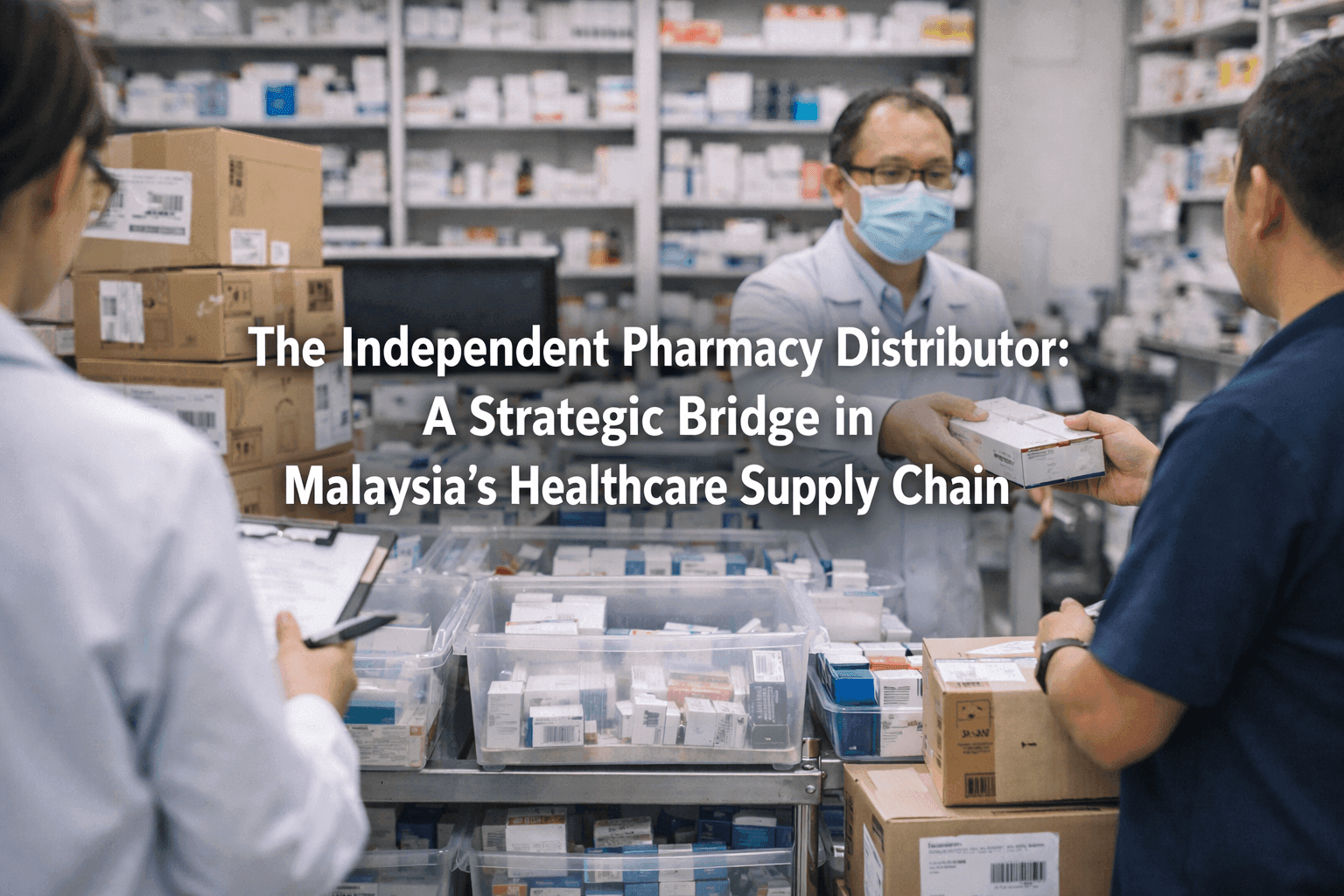
Independent pharmacy distributors have quietly become the backbone of pharmaceutical accessibility in Malaysia, yet their role is often misunderstood or simply overlooked. Unlike their large-scale counterparts with sprawling warehouses and fleets of branded lorries, these agile players operate differently—and that difference matters. They do not simply move products from Point A to Point B. Instead, they function as strategic intermediaries, forging connections between international manufacturers and the neighbourhood pharmacies that serve millions of Malaysians daily.
Consider the pharmacy located in a small town like Bentong or Kuala Kubu Bharu. It cannot possibly order directly from a multinational pharmaceutical manufacturer in Europe or India. Minimum order quantities are prohibitive, logistics are complex, and regulatory requirements feel insurmountable. This is where independent pharmacy distributors step in. They consolidate orders, navigate the labyrinth of NPRA product registration, and deliver precisely what that pharmacy needs—often within 24 hours. They are not merely delivery agents; they are essential enablers of healthcare equity across urban and rural Malaysia.
One real-world example comes from a distributor pharmacy based in Johor Bahru that services over 200 independent pharmacies across Johor, Melaka, and Pahang. Instead of competing with the big players on volume, they compete on responsiveness and relationship. When a pharmacy in Segamat runs unexpectedly low on antihypertensive medications, a call to this distributor triggers a same-day dispatch. No minimum order penalty. No bureaucratic delay. This is not just efficiency—it is proven, reliable service that keeps patients adherent to their treatment regimens.
From the perspective of the pharmacist, this relationship is invaluable. “We cannot afford to hold six months of inventory,” explains a community pharmacist in Seremban. “But our patients expect their chronic disease medications to be available when they walk in. Independent distributors understand this. They are not just vendors—they are strategic partners.” The pharmacist’s loyalty, in turn, provides the distributor with predictable order patterns and opportunities to introduce new products.
For brand managers at pharmaceutical companies, independent distributors offer something equally valuable: market penetration without infrastructure investment. A Malaysian-made topical analgesic brand recently achieved 85 percent pharmacy availability within eight months—not through direct sales, but through a curated network of 12 independent distributors. Each distributor understood local prescribing habits, seasonal demand fluctuations, and even which clinics referred patients to which pharmacies. That is tailored intelligence no algorithm can replicate.
Learn more: The Role of Pharmacy Distribution Services in Malaysia’s Healthcare System
Compliance Without Compromise: Meeting NPRA, GMP, and KKM Standards Independently
Regulatory compliance is often cited as the greatest barrier to entry in pharmaceutical distribution. It is also the greatest differentiator between professional operators and those who do not survive their first audit. Independent pharmacy distributors in Malaysia operate under the same National Pharmaceutical Regulatory Agency (NPRA) requirements, Good Manufacturing Practice (GMP) standards for handling, and Ministry of Health (KKM) enforcement as the largest corporations. There is no exemption for being small.
What sets successful independent distributors apart is their deliberate investment in compliance infrastructure. A pharmacy distributor in Penang recently achieved ISO 9001:2015 certification—a voluntary but powerful signal to brand owners that their products are handled with proven quality control. The process required 18 months, external auditors, and significant staff training. But the result was immediate: three multinational principals who had previously declined partnership initiated contract discussions within weeks of the certification announcement.
Data supports this shift. According to industry estimates, independent pharmacy distributors now account for approximately 28 percent of the pharmaceutical wholesale distribution volume in Malaysia’s private sector—up from 19 percent in 2018. Much of this growth is attributed not to price, but to trusted compliance records and the ability to serve pharmacies that major wholesalers find economically unviable.
From a brand manager’s perspective, compliance is non-negotiable. “We cannot afford reputational damage from a distributor who cuts corners on cold chain storage or documentation,” states a regulatory affairs manager at a multinational pharmaceutical company with operations in Selangor. “When we evaluate partners, their SOP adherence and audit history carry equal weight to their commercial capabilities. A compliant independent distributor is actually more attractive to us than a non-compliant major player.”
Yet compliance for independents is not without pain points. Storage facility upgrades, temperature-monitoring systems, and trained pharmacy distribution services personnel require capital that is not always readily available. This is where strategic collaboration with principals can make a meaningful difference. Several Malaysian pharmaceutical manufacturers now offer co-investment programmes, sharing the cost of cold room installations or fleet refrigeration units with their distributor partners. It is a pragmatic, mutually beneficial arrangement that strengthens the entire supply chain.
For the end patient, this invisible compliance work translates into something simple but profound: confidence. When a mother purchases paediatric antibiotics from her local pharmacy in Kota Kinabalu, she does not ask whether the product was stored at the correct temperature during transit. She assumes it was. Independent pharmacy distributors, through their uncompromising adherence to regulatory standards, honour that assumption every single day.
Comparative Performance: In-House Teams Versus Independent Merchandisers
One of the most persistent debates in pharmaceutical distribution strategy centres on merchandising. Should brand owners deploy their own in-house sales and merchandising teams, or should they rely on distributor-employed merchandisers who carry multiple principals’ products? The answer, increasingly supported by performance data, is not binary—but context matters significantly.
Below is a comparative framework illustrating typical performance indicators across both models in the Malaysian pharmacy retail environment:
| Performance Indicator | In-House Merchandising Team | Independent Distributor Merchandiser |
|---|---|---|
| Product Knowledge Depth | High for own brand; limited for competitors | Moderate across multiple brands; adaptive |
| Shelf-Audit Frequency | Weekly to biweekly (urban); monthly (rural) | Every visit (integrated into delivery) |
| Cost Per Call | High (salary, transport, management overhead) | Lower (shared across principals) |
| Relationship with Pharmacy Staff | Professional but transactional | Often long-standing; informal and trusted |
| New Product Introduction Speed | Fast in high-potential outlets | Slower but broader rural reach |
| Expiry Stock Management | Requires separate visit or request | Often handled immediately during delivery |
| Compliance Documentation Handling | Centralised; slower for ad-hoc requests | Decentralised; faster for urgent documentation needs |
| Market Intelligence Feedback | Structured reports; may lack local nuance | Informal but rich; reflects actual point-of-sale conditions |
The strategic implication is clear: neither model is universally superior. A multinational brand launching a high-investment cardiovascular therapy may still prefer in-house specialists for key urban pharmacies. However, for sustained availability, expiry management, and rural penetration, independent distributor merchandisers often deliver more reliable outcomes at a lower total cost.
A Selangor-based pharmacy chain with 28 outlets provides an illustrative example. When a major cough and cold brand shifted from an in-house merchandising model to distributor-integrated merchandising, out-of-stock rates for their core SKUs dropped from 11 percent to 4 percent within three months. The reason? Merchandisers were already visiting the pharmacies weekly for deliveries. Checking stock levels, facing up shelves, and removing near-expiry units required only an additional 10 minutes per visit. No extra travel cost. No appointment scheduling friction.
Pharmacists themselves express a preference for this integrated model. “We have 15 to 20 representatives visiting each week,” shares a pharmacy manager in Kuching. “If the person delivering our order can also tidy the shelf and check expiries, that is one less interruption to our dispensing workflow. It is simply more efficient.” This operational reality is driving a gradual but unmistakable shift in how pharmacy distribution Malaysia models are being restructured.
Tailored Solutions: Addressing the Unique Challenges of Independent Pharmacies
Independent pharmacies in Malaysia face a paradox. They are often the most accessible healthcare touchpoints for local communities, yet they operate with significantly less bargaining power and infrastructure support than large chains. This is where progressive pharmacy distributors have identified not a problem, but an opportunity.
The challenges confronting independent pharmacies are not monolithic. A pharmacy in Chow Kit, Kuala Lumpur contends with high foot traffic but intense competition, limited storage space, and a transient customer base. A pharmacy in Sandakan struggles with supply chain lead times, restricted cold chain capacity, and lower patient purchasing power. A pharmacy in Petaling Jaya deals with discerning customers who expect the same brands and formulations available in Singapore or Australia. No single distribution model fits all.
Effective pharmacy distributors have responded with segmented service offerings. One Kuala Lumpur-based distributor now provides three distinct service tiers: basic wholesale supply for price-sensitive pharmacies, full-service consignment stock for pharmacies seeking to minimise inventory risk, and category management support for pharmacies wanting to optimise their over-the-counter and health supplement sections. This is not merely distribution—it is strategic consultancy embedded within logistics.
Consider the case of a single-outlet pharmacy in Shah Alam that was struggling to compete with nearby chain pharmacies on vitamin and supplement pricing. Their distributor did not simply lower margins—they provided a customised planogram, recommended a curated range of 25 high-turnover SKUs instead of 80 slow-moving lines, and introduced a supplier-funded end-cap display. Within four weeks, the pharmacy’s supplement sales increased by 34 percent, and inventory holding days dropped from 68 to 31. The pharmacist’s relief was palpable: “I trained as a pharmacist, not a retail buyer. Having a distributor who understands both is like having an expert partner.”
From the distributor’s perspective, this level of customisation requires operational flexibility. It demands merchandisers who can think beyond checklists, inventory planners who analyse sell-through data rather than purchase orders, and management willing to accept that not every pharmacy needs the same delivery frequency or credit terms. It is a more demanding business model—but it is also a defensible competitive advantage.
The Collaboration Advantage: How Distributor Partnerships Strengthen the Entire Ecosystem
Collaboration is frequently cited in corporate mission statements but rarely practiced with genuine commitment. In Malaysia’s pharmaceutical distribution landscape, however, a growing number of independent distributors and brand owners are demonstrating what authentic partnership looks like—and the results challenge conventional assumptions about vertical integration.
A notable example involves a European dermatology brand seeking to expand its presence in Malaysia’s private pharmacy sector. Rather than establishing a direct distribution office—a capital-intensive endeavour requiring regulatory registration, warehouse leasing, and staff recruitment—they partnered exclusively with a Penang-based pharmacy distributor that already serviced 450 private clinics and 200 retail pharmacies. The arrangement was not transactional. The distributor was granted first-visit rights for all new product launches, access to the principal’s regional training resources, and input into packaging quantities suitable for the Malaysian market.
In return, the distributor committed to dedicated sales coverage, real-time inventory reporting, and proactive brand retrieval from non-performing outlets. Within 18 months, the brand achieved 17 percent value share in the dermatological skincare segment—a performance that exceeded the principal’s Southeast Asian regional average. This is not distribution. This is co-creation.
For independent pharmacies, this collaboration cascade creates tangible benefits. When distributors and brand owners align their objectives, pharmacy customers experience fewer stock disruptions, more relevant product assortments, and better-informed pharmacy staff who receive training materials cascaded through the distributor’s network. A pharmacist in Ipoh describes the difference: “Previously, if a product was out of stock at the distributor, I had no visibility on when it would return. Now, with better communication between the brand and the distributor, I get restock dates and alternative recommendations proactively. It reduces my anxiety and my patients’ frustration.”
Regulatory collaboration is another emerging dimension. Several pharmacy distributors Malaysia now participate in early engagement sessions with NPRA regarding new product classification guidelines or cold chain inspection protocols. By contributing operational perspectives—what is feasible in a typical delivery van versus what requires specialised vehicles—they help shape pragmatic regulations that maintain safety without imposing impractical burdens. This elevates their role from passive compliance followers to active industry contributors.
Frequently Asked Questions (FAQ)
Q1: What is the largest healthcare company in Malaysia?
Answer: The largest healthcare company in Malaysia is KPJ Healthcare Berhad, a leading private healthcare provider with a wide network of hospitals across the country.
Q2: Who are the leading companies in the healthcare industry?
Answer: Leading healthcare companies in Malaysia include KPJ Healthcare Berhad, IHH Healthcare, Pharmaniaga, and Pantai Medical Group, which are all prominent players in the healthcare and pharmaceutical sectors.
Q3: What is the ranking of Malaysia in healthcare?
Answer: Malaysia is ranked 61st globally in healthcare access and quality according to the 2018 Global Health Security Index, with a strong healthcare infrastructure and access to medical services.
Q4: What are the top 10 health insurance companies in Malaysia?
Answer: Top health insurance companies in Malaysia include AIA Malaysia, Prudential Assurance, Great Eastern Life, Allianz Life, Tokio Marine Life, Sun Life Malaysia, Manulife Insurance, Etiqa Insurance, AXA Affin Life, and Hong Leong Assurance.
Q5: Who are the top 7 companies?
Answer: The top 7 companies in Malaysia’s healthcare and pharmaceutical sector are KPJ Healthcare, IHH Healthcare, Pharmaniaga, Pantai Medical Group, Sunway Medical Centre, KPJ Healthcare, and the Ministry of Health (MOH).
Q6: What are the big 4 companies in Malaysia?
Answer: The “Big 4” in Malaysia typically refers to the largest multinational professional services firms: Deloitte, PricewaterhouseCoopers (PwC), Ernst & Young (EY), and KPMG.
Q7: What is the most famous hospital in Malaysia?
Answer: The most famous hospital in Malaysia is the Hospital Kuala Lumpur, renowned for its state-of-the-art facilities and comprehensive healthcare services.
Q8: What are the big 10 companies?
Answer: The top 10 companies in Malaysia, considering healthcare and pharmaceutical sectors, include KPJ Healthcare, IHH Healthcare, Pantai Medical Group, Pharmaniaga, Sunway Medical Centre, and others.
Q9: What are the top 5 pharmacy in Malaysia?
Answer: The top 5 pharmacies in Malaysia include Guardian, Watsons, Caring Pharmacy, Alpro Pharmacy, and Health Lane Family Pharmacy, which dominate the retail pharmacy market.
Q10: What is the biggest company in Malaysia?
Answer: The biggest company in Malaysia by market capitalization is Malayan Banking Berhad (Maybank), a leading financial services group in the region.
How can we assist you today? 😊
Just let us know—we’re here to help!